Semi-Recessed Cold Room Door (Semi-Flush Hinged Door)
I. Structural Definition
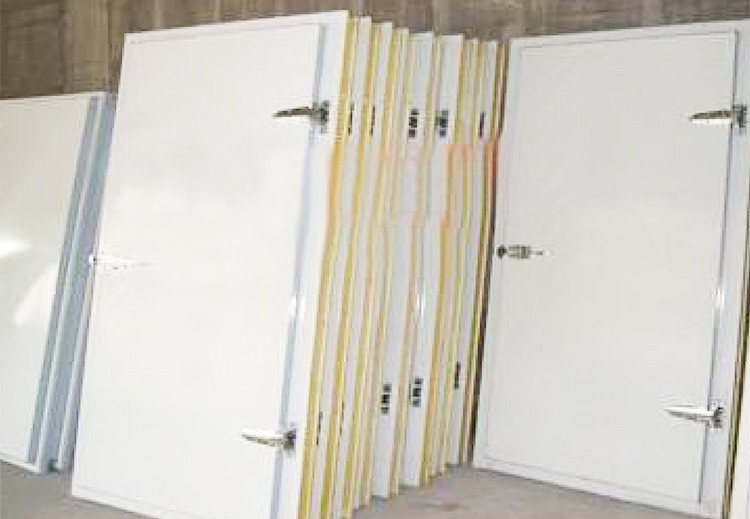
The door leaf is half embedded in the door frame and half exposed (unlike a fully recessed door where the entire leaf is set into the frame, or a surface-mounted door where the whole leaf is outside). It is a manual swing insulated cold room door and the mainstream standard configuration for small cold rooms.
Core material: High-density rigid polyurethane integral foam (40~45kg/m³), no cold bridge, thermal insulation and flame retardant.
Panel: 304 stainless steel / color steel plate / embossed aluminum plate (stainless steel is preferred for food storage rooms).
Door panel thickness: 50/75/100/150/200mm (100mm is commonly used for cold storage at 18°C; ≥150mm for freezing at -35°C).
Sealing: Magnetic EPDM sealing strips embedded in the door frame, multi-channel sealing to prevent cold air leakage; low-temperature cold room door frames are standardly equipped with self-limiting temperature electric heat tracing tape (to prevent frost and door freezing).
II. Specifications
1. Common door opening dimensions (custom sizes available)
Single door: 700×1700, 800×1800, 900×2000mm (standard: 800×1800)
Double door: 1200×2000, 1500×2100mm
2. Applicable temperature: -45°C to +50°C, suitable for cold storage, freezing, and fresh-keeping rooms.
III. Core Accessories
1. Safety door lock: Internal and external linked handles, with a built-in escape push bar inside the room (if trapped, the door can be unlocked by pushing from the inside; mandatory safety configuration for cold rooms).
2. Reinforced hinges: Stainless steel thickened hinges, load-bearing and deformation-resistant.
3. Optional: Round/square tempered glass observation window, small access door on the main door (for small items without opening the large door), anti-collision edge protection.
IV. Advantages and Disadvantages
✅ Advantages
1. High cost-effectiveness, simple installation, lower cost than fully recessed doors, suitable for both civil and prefabricated cold rooms.
2. Better sealing and insulation than surface-mounted protruding doors, with lower cold loss.
3. Easy maintenance and replacement of sealing strips, low failure rate.
❌ Disadvantages: Insulation and airtightness are slightly inferior to fully recessed embedded doors, not suitable for cold rooms with very high-frequency forklift traffic.
V. Applicable Scenarios
Small fresh-keeping/freezing cold rooms, fresh food supermarket cold rooms, low-temperature food processing workshops, pharmaceutical cool storage rooms (mainly manual access, no forklifts).
VI. Brief Distinction Between Semi-Recessed and Fully Recessed Doors
Semi-recessed door: Half embedded in the frame, low cost, quick installation, first choice for small and medium cold rooms.
Fully recessed door: Door leaf completely set into the frame, flush with the wall, better insulation and sealing, higher cost, used in large and medium cold chain warehouses.