Evaporative Condenser
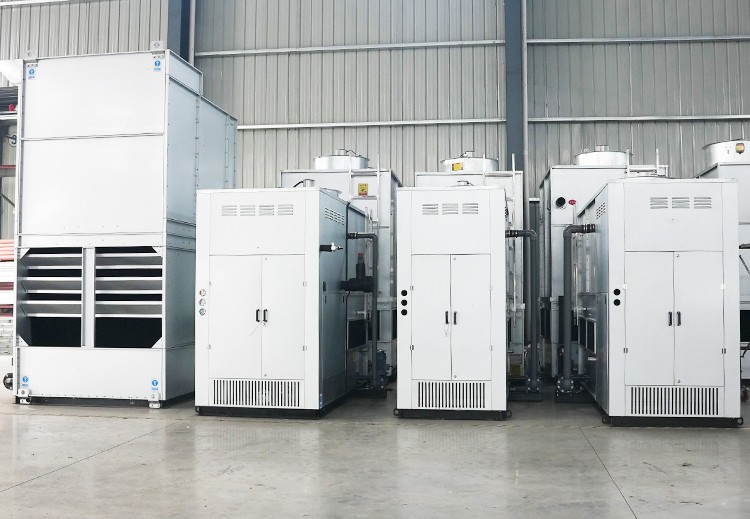
An evaporative condenser, also known as an "evaporative cooler," is a highly efficient heat exchange device that integrates the functions of a cooling tower and a condenser. It is primarily used to condense high-temperature, high-pressure refrigerant vapor into liquid in refrigeration systems. By combining the action of water and air, it utilizes the heat-absorbing effect of partial water evaporation to remove heat from the refrigerant, offering advantages such as low energy consumption, high heat exchange efficiency, and compact structure.
Working Principle
The core principle of an evaporative condenser is evaporative cooling, and the specific process is as follows:
High-temperature, high-pressure gaseous refrigerant discharged from the compressor enters the condenser coil from the top.
The circulating water pump delivers water from the sump to the top nozzles, which spray it evenly over the outer surface of the condenser coil, forming a thin water film.
The axial fan forces air to pass over the condenser coil at a speed of 3–5 m/s, promoting evaporation of the water film.
As the water evaporates, it absorbs a large amount of latent heat (approximately 540 kcal/kg), rapidly removing heat from the refrigerant inside the coil, causing it to cool and liquefy.
Non-evaporated water falls into the sump for recirculation, while evaporated water vapor is discharged with the air by the fan. The system automatically replenishes water through a float valve.
In simple terms, it ingeniously combines water cooling and air cooling technologies, eliminating the traditional stage of transferring cooling water from the condenser to the cooling tower, and structurally integrating the condenser and cooling tower into one unit.
Main Structural Components
Condenser coil assembly: Typically made of hot-dip galvanized carbon steel tubes, aluminum alloy tubes, or stainless steel tubes, used to transport refrigerant.
Spray system: Includes nozzles, water distributors, etc., to evenly spray water over the coil surface.
Axial fan: Drives airflow, accelerating water evaporation and heat removal.
PVC heat exchange sheets/fill: Increases heat exchange area and improves heat transfer efficiency.
High-efficiency drift eliminator (water catcher): Retains water droplets entrained in the airflow, reducing water loss.
Water tank and circulating pump: Stores and recovers non-evaporated water for recirculation.
Main Advantages
High efficiency and energy saving: Cooling efficiency is 30%–50% higher than air-cooled condensers, and energy consumption is approximately 15%–20% lower than traditional water-cooled condensers.
Water saving and environmentally friendly: The recirculating water design uses only 45%–50% of the water required by traditional water-cooled systems, making it suitable for water-scarce regions.
Compact structure: Small footprint, integrating refrigeration and condensation functions, ideal for space-constrained installations.
Low operating costs: Reduced compressor power consumption and higher overall system efficiency.
Limitations and Precautions
High water quality requirements: Continuous water treatment is needed to prevent scaling, corrosion, and biological growth.
Environmental impact: Efficiency is higher in hot, dry climates; in high-humidity environments, evaporation efficiency decreases.
Maintenance costs: Regular cleaning of coils, sump, fan, and pump is required, increasing labor and operational costs.
Higher initial investment: Compared to some air-cooled systems, the initial investment in equipment and infrastructure is greater.
Application Areas
Evaporative condensers are widely used in fields requiring efficient heat dissipation and energy savings:
Industrial refrigeration: Large cold storage, food processing, cold chain logistics
HVAC: Large central air conditioning systems
Petrochemical: Gas cooling and condensation in high-temperature processes
Power industry: Generator cooling, steam condensation
New energy: Solar power, wind power, and data center cooling
Market Size
According to data from Verified Market Reports, the global evaporative condenser market was approximately USD 1.50 billion (approximately RMB 10.683 billion) in 2024. The Chinese market has shown strong growth in recent years in areas such as refrigeration equipment manufacturing, petrochemicals, cold chain logistics, and data center construction.