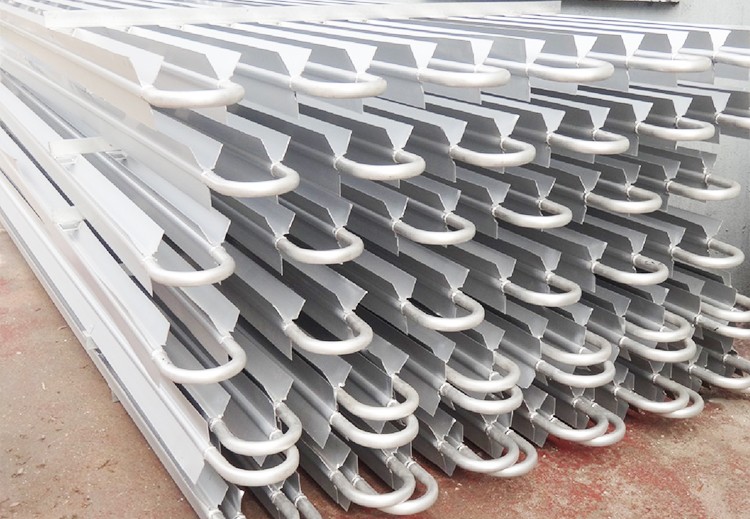
Aluminum fin tube evaporator (also known as "aluminum fin coil") is the "silent and energy-saving steward" of cold rooms. It cools by laying finned aluminum alloy pipes on the ceiling or walls, utilizing refrigerant evaporation and natural air convection (no fans). Compared to unit coolers, it is extremely energy-efficient, completely silent, and minimizes food dehydration, but has higher initial investment and slower cooling.
1. 2026 Price Reference
Aluminum fin coils are usually quoted "per meter," with prices depending on the number of fins (heat exchange area):
Specification (mainstream pipe diameter Φ25-Φ32mm) Reference Unit Price (RMB/meter) Applicable Scenarios & Features
Two-fin aluminum coil (basic model) 18 – 28 Small fresh-keeping rooms, budget-sensitive projects, heat exchange area approx. 0.3 m²/meter
Three-fin aluminum coil (mainstream model) 25 – 40 First choice for fruit cold rooms (0~5℃) and freezer rooms, high cost-performance
Four-fin/heavy-duty model 35 – 60+ Ultra-low temperature rooms, high-humidity rooms, stronger pressure resistance and heat exchange performance
Note: The above prices are for the aluminum fin coil pipes only. Installation costs (including hoisting, elbows, welding, and vacuuming) are usually equivalent to the material cost. That is, if you buy 10,000 RMB worth of aluminum fin coils, installation labor + auxiliary materials will likely cost an additional 8,000–12,000 RMB.
2. Aluminum Fin Coil vs. Unit Cooler: Which Should a Fruit Cold Room Choose?
You previously asked about fruit cold rooms—this is exactly where aluminum fin coils excel. The core differences between the two are as follows:
Aspect Aluminum Fin Coil (Natural Convection) Unit Cooler (Forced Convection)
Fruit Preservation (Dehydration) ✅ Excellent. No air blowing, high humidity, fruits are less prone to wrinkling and weight loss. ❌ Poor. Fan blowing removes moisture, causing fruits to shrivel.
Energy Consumption ✅ Extremely low. No fan motor, long-term operation saves 15%–30% energy compared to unit coolers. ❌ Higher. Fan runs 24/7, and defrosting is frequent.
Noise ✅ Completely silent. ❌ Fan noise present.
Cooling Speed ❌ Slow. Relies on natural convection; takes longer to reach set temperature after loading. ✅ Extremely fast. Suitable for transit cold rooms with frequent loading and unloading.
Initial Investment ❌ High. Material + installation cost is usually 1.5–2 times that of unit coolers. ✅ Low. Equipment is cheaper and installation is simple.
Decision Recommendations:
• If your fruits need to be stored for more than 1 month (e.g., apples, pears for off-season sales): definitely choose aluminum fin coils—the electricity savings and reduced product loss (dehydration) will quickly offset the initial investment.
• If it is a wholesale outlet with daily loading and unloading: choose a unit cooler for fast cooling and resistance to frequent door openings.
3. Implementation Recommendations and Pitfall Avoidance Guide
1. Sizing Calculation: Don't Just Look at Area
◦ Empirical formula: For -18℃ freezer rooms, aluminum fin coil evaporation area ≈ compressor displacement (m³/h) × 2. For 0℃ fruit rooms, the coefficient can be appropriately reduced.
◦ Room capacity estimation: For small rooms below 100m³, aluminum fin coil area ≈ room floor area × 2.5.
◦ Specification selection: For fruit rooms (0~5℃), three-fin aluminum fin coils are recommended for high cost-performance; if extremely high humidity is required (e.g., lychees, leafy greens), consider four-fin coils.
2. Local Installation Notes
◦ Load-bearing is not an issue: Aluminum fin coils are very light (1/5 the weight of steel fin coils of the same area), and standard polyurethane panel ceilings can easily support them without additional reinforcement.
◦ Defrosting strategy: Winter is dry, but fruit rooms (above 0℃) must have automatic defrosting (hot gas or electric). Manual defrosting is extremely difficult for high-rack warehouses; be sure to include an automatic defrosting system in the quotation.
3. Pitfall Avoidance Points
◦ Don't buy "non-standard" products just to save money: There are inferior aluminum fin coils on the market with wall thickness less than 1.2mm, which have poor pressure resistance and are prone to refrigerant leaks. Always require wall thickness ≥ 1.5mm (reputable manufacturers typically use 1.8–2.0mm).
◦ Ask for an "all-inclusive price": Many quotations only cover the aluminum pipe cost; later items such as liquid distributors, U-bends, hanger rods, nitrogen for welding, and vacuuming are major additional costs. Be sure to have the local Zhengzhou contractor provide a fixed price that includes installation and pressure testing.
4. Budget Estimation Example
Assume you are building a 100m² (3m high) fruit cold room (0~5℃):
• Aluminum fin coil requirement: approximately 250–300 meters of three-fin aluminum fin coil (estimated at 2.5 times the floor area).
• Material cost: 300 meters × 30 RMB/meter ≈ 9,000 RMB.
• Installation cost: approximately 8,000 – 12,000 RMB (including auxiliary materials, welding, and commissioning).
• Total: approximately 20,000 RMB (aluminum fin coil system only, excluding insulation panels, condensing units, etc.).