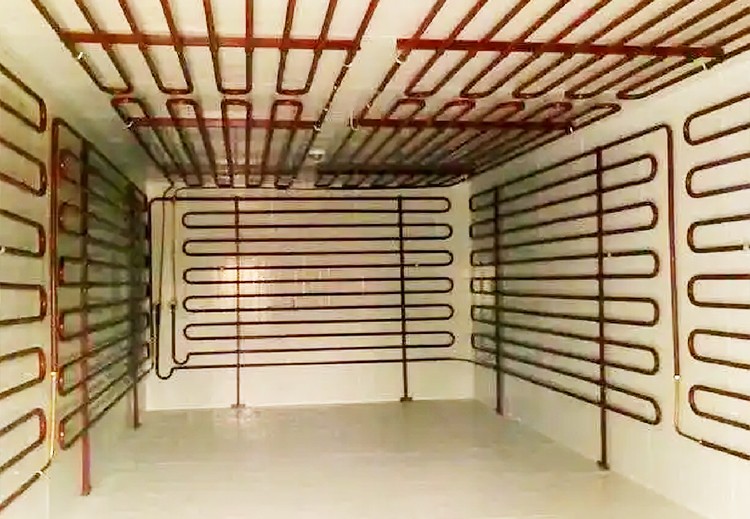
Steel pipe evaporator (seamless steel pipe / galvanized steel pipe) is the "old-school tough guy" of cold storage, known for durability and low dehydration loss. It relies on natural convection heat exchange without fans, making it ideal for long-term storage in low-temperature freezers where air drying is a concern.
1. 2026 Price Reference
Steel pipe evaporators are typically quoted by "evaporative area" or "complete cold room package," with prices significantly affected by pipe wall thickness and anti-corrosion treatment:
Specification/Type Reference Price Application Scenario
Bare steel pipe (ceiling / wall mounted) RMB 80 – 120 / m² (evaporative area) General low-temperature cold room, requires on-site welding
Galvanized steel pipe (anti-corrosion) RMB 100 – 150 / m² (evaporative area) High-humidity environments, high rust resistance required
Complete small cold room (50 m³) RMB 5,000 – 8,000 (installation included) Long-term storage of meat / seafood
Complete large cold room (500 m³) RMB 30,000 – 50,000 (installation included) Logistics distribution centers, industrial cold storage
Note: The above are reference prices for equipment and installation. If hot-gas defrosting is required, the price increases by 20%–30%.
2. Steel Pipe vs. Aluminum Pipe: Key Differences
You previously inquired about aluminum pipe evaporators. The core difference between the two lies in the trade-off between "strength" and "efficiency":
Aspect Steel Pipe Aluminum Pipe (Reference)
Thermal Conductivity Lower (thermal conductivity approx. 45 W/m·K), requires larger evaporative area Extremely high (approx. 237 W/m·K), fast heat exchange
Corrosion Resistance Prone to rust, requires galvanizing or paint maintenance Naturally corrosion-resistant, maintenance-free
Mechanical Strength Extremely high, impact-resistant, suitable for forklift operation areas Relatively soft, prone to deformation, requires protection
Initial Cost Low (approx. 60%–70% of aluminum pipe) High
Long-term Electricity Cost Higher (due to lower efficiency, compressor runs longer) Extremely low (energy savings of approx. 30%)
Selection Recommendations:
• Choose steel pipe: limited budget, frequent forklift traffic in the cold room that may damage equipment, or when used as a load-bearing structure for rack-type blast freezers.
• Choose aluminum pipe: pursuit of maximum energy savings, high-humidity environments (e.g., seafood storage) where rust is a concern, or new high-standard cold storage construction.
3. Implementation Recommendations and Pitfall Avoidance Guide
1. Rust Prevention in High-Humidity Environments
◦ Anti-corrosion treatment is essential: In humid summer conditions, ordinary carbon steel is highly prone to rust. Be sure to require the manufacturer to apply hot-dip galvanizing or epoxy resin coating. Low-quality paint will peel within months, and rust debris can clog filters and ruin the entire refrigeration system.
◦ Drainage design: Steel pipe evaporators produce a large amount of condensate during defrosting. A freeze-resistant drain pipe (with heating wire) must be pre-installed inside the cold room to prevent the drain outlet from freezing in winter.
2. Defrosting Strategy is Critical
◦ Steel pipe evaporators cannot perform automatic electric defrosting like unit coolers. The mainstream solutions are hot-gas defrosting (using compressor discharge gas) or manual defrosting.
◦ Pitfall avoidance: For fruit preservation cold rooms (above 0°C), frost buildup on steel pipes is not severe, so manual defrosting is acceptable. For -18°C freezers, it is strongly recommended to install a hot-gas defrosting system; otherwise, manual defrosting will be extremely labor-intensive.
3. Space Requirement Warning
◦ Steel pipe evaporators have lower heat exchange efficiency, requiring a larger installation area to achieve the same cooling capacity. Sufficient ceiling or wall space must be reserved during design; otherwise, the cold room temperature may not drop to the desired level.
4. Budget Estimation Example
Assume you are building a 100 m³ meat freezer (-18°C):
• Selection: Bare steel pipe (ceiling + wall mounted), evaporative area approx. 80 m².
• Budget estimate: Material cost 80 m² × RMB 100/m² ≈ RMB 8,000 + installation fee approx. RMB 3,000 = RMB 11,000 (evaporator system only).
In summary: Steel pipe evaporators represent the "save money now, deal with hassle later" approach. They have low initial investment and are rugged and durable, making them suitable for long-term storage facilities with tight budgets, where goods are sensitive to air drying and turnover is infrequent. However, in high-humidity regions, rust prevention maintenance and defrosting convenience are cost pain points that must be planned in advance. If the budget allows, aluminum pipe evaporators are generally the better modern solution in terms of energy efficiency and maintenance convenience.