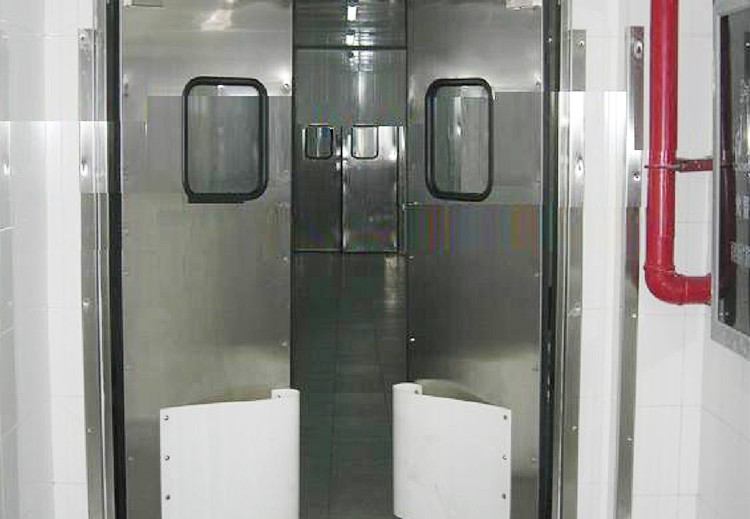
A stainless steel double-acting swing door (also known as an impact-resistant free door or double-way passage door) is an industrial or commercial door that requires no electric power, opens in both directions, and automatically returns to close. It mainly utilizes an eccentric pivot design or double-action spring hinges, relying on the door's own weight or the rebound force of built-in springs to close quietly after personnel or vehicles pass through.
Below is a detailed analysis of the stainless steel double-acting swing door:
Core Materials and Structure
Door Body Material: The door panel surface typically uses full-thickness (e.g., 1.0mm) SUS304 stainless steel sheets, offering excellent corrosion and rust resistance, and is easy to rinse and clean. The interior of the door body is usually composed of multi-layer wood boards or lightweight aviation-grade aluminum materials bonded with high-density polyurethane adhesive to ensure impact resistance, sound insulation, and thermal insulation.
Impact-Resistant Design: The lower section of the door body is typically equipped with a black teardrop-shaped PE impact plate or rubber-plastic impact plate (approximately 0.6 meters high), which effectively withstands direct impacts from forklifts, hydraulic pallet trucks, or hand carts, preventing door deformation.
Window and Sealing: A 5mm thick transparent acrylic window is often embedded in the middle of the door leaf for visibility on both sides; the door body is fitted with wear-resistant rubber sealing strips around the perimeter to ensure a tight seal when closed.
Key Functional Features
Bidirectional Free Passage: Supports pushing open from both inside and outside, eliminating the need for manual opening or closing, greatly improving the efficiency of personnel and goods movement.
Automatic Self-Closing: Utilizing the mechanical principle of eccentric pivots or spring hinges, the door automatically, slowly, and quietly returns to its closed position after opening, without manual intervention, effectively preventing the door from banging in the wind.
Environmental Isolation: When closed, it provides effective protection against insects, dust, drafts, heat loss, cold, and odors, helping to maintain indoor cleanliness.
Extended Durability: Equipped with heavy-duty offset pivots or thickened 304 stainless steel spring hinges, resulting in minimal mechanical wear and a service life of over 50,000 cycles.
Applicable Scenarios
Stainless steel double-acting swing doors are widely used in places that require frequent access and have certain environmental hygiene requirements, including:
Food Processing and Pharmaceuticals: Food workshop passages, seafood rooms, cold storage, clean rooms, pharmaceutical factories, etc.
Commercial and Catering: High-end hotel kitchens, supermarkets, restaurant back kitchens, bar partitions, etc.
Industrial and Warehousing: Logistics warehouses, factory internal passages, postal sorting centers, etc.
Purchasing and Customization Recommendations
Size Customization: Manufacturers typically support non-standard customization based on actual door opening dimensions. Common specifications include single doors such as 900mm × 2100mm, and double doors such as 1500mm × 2100mm.
Hardware Accessories: It is recommended to pay special attention to the quality of hinges (spring hinges). High-quality double-action spring hinges not only provide smooth and gentle rebound without pinching fingers but also allow three-dimensional adjustment to ensure the door panel remains aligned and does not sag over time.
Procurement Process: Reputable manufacturers generally provide a standardized service process that includes requirement communication, solution design, sample confirmation, contract signing, deposit and balance payment, and delivery.