

Products
Contact Us
Senbin Holding (Hubei) Co., Ltd.
Group Headquarters · Contact Information
Address: 13F, Xinsite Industrial Park, Qixiong Road, Dongxihu District, Wuhan, China
Tel: +86-13377865336 (Manager Shen) +86-400 009 9929
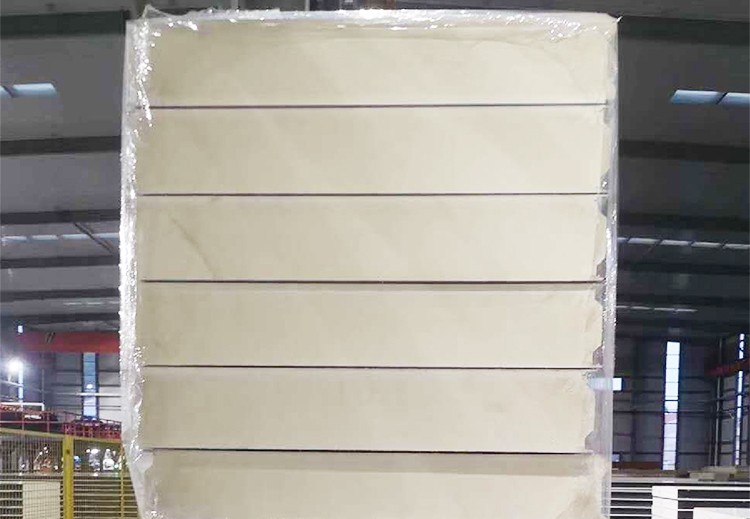
Product Name: B1 Grade Polyurethane Cold Storage Panel
Updated:2026-08-14
B1 grade polyurethane (PU/PIR) cold storage panel (standard panel for cold rooms equipped with semi-embedded cold room doors + ceiling-mounted air coolers and V-type condensers)
Standards: GB8624-2012 (B1 flame retardant), JB/T6527-2006, T/CECS10276-2023
1. Structure (Sandwich Panel)
1.1 Facings (both sides)
Standard: 0.4–0.6mm color-coated galvanized steel sheet (PE polyester coating); for seafood/chemical rooms, choose 0.45–0.7mm 304 stainless steel; anti-corrosion option: embossed aluminum sheet.
Surface: flat or micro-ribbed profile to prevent bulging and enhance bonding strength.
1.2 Core material (B1 flame-retardant rigid polyurethane)
Two types available:
PU standard B1 polyurethane: density 40±2 kg/m³, closed cell ratio ≥97%, thermal conductivity ≤0.023–0.024 W/(m·K)
PIR modified B1 (for high-end pharmaceutical/GSP cold rooms): density 45–50 kg/m³, thermal conductivity ≤0.020 W/(m·K), superior flame retardancy and high-temperature resistance
1.3 Joint system: tongue-and-groove with built-in eccentric metal hooks, low-temperature sealant applied in grooves, thermal bridge-free design to prevent cold loss at seams (especially critical for wall panels around semi-embedded doors)
2. Key B1 Fire Performance Indicators (Mandatory for Acceptance)
B1 flame-retardant grade: oxygen index ≥30%, self-extinguishing within 3s after flame removal, no molten dripping (d0), low smoke toxicity (t0);
B2 and B3 flammable grades are strictly prohibited for formal cold room fire safety acceptance.
3. Common Thickness Selection (Based on Room Temperature, Matches Your Air Coolers)
| Room Temperature Condition | Recommended Panel Thickness | Applicable Unit Type |
|---|---|---|
| +5°C to 0°C fruit & vegetable preservation, DL air cooler | 100mm | High-temperature preservation rooms, small cool rooms |
| -18°C freezing, DD air cooler (mainstream) | 150mm | Fresh meat and frozen product rooms (standard with semi-embedded door) |
| -25°C to -35°C DJ low-temperature quick freezing | 200mm | Low-temperature quick-freezing rooms |
4. Core Physical Parameters (National Standard)
Compressive strength: ≥160 kPa (premium PIR ≥220 kPa)
Water absorption: ≤4%, dimensional stability ≤3%
Service temperature: -40°C to +100°C, suitable for all temperature range cold rooms
5. Panel Classification & Application Scenarios
1. Color-coated steel (best cost-performance): standard meat, fruit & vegetable freezing rooms;
2. 304 stainless steel: seafood rooms, saltwater rooms, food processing areas, pharmaceutical cold rooms;
3. Aluminum sheet: high-humidity, highly corrosive storage rooms.
6. Advantages & Disadvantages
✅ Advantages
1. Excellent insulation, saves 25%+ energy compared to EPS panels, compatible with V-type condenser units to reduce condensing load;
2. B1 flame retardancy meets fire safety inspection requirements, pharmaceutical cold rooms pass GSP;
3. Quick assembly, dry installation on site, pre-cut openings for semi-embedded cold room doors.
❌ Disadvantages
1. Higher unit price than EPS panels of the same thickness; inferior B1 panels with added fillers may have insufficient density and false flame-retardant ratings.
7. Installation Points (Matching Semi-Embedded Doors)
1. Cut whole panels around the door opening to avoid small-piece joints that cause cold loss;
2. Install wall panels vertically, ceiling panels horizontally, apply double sealant lines on both sides of panel joints;
3. Pre-embed mounting brackets for air cooler suspension, and properly insulate and finish around panel openings.
|
Previous: None
|
Back to List |