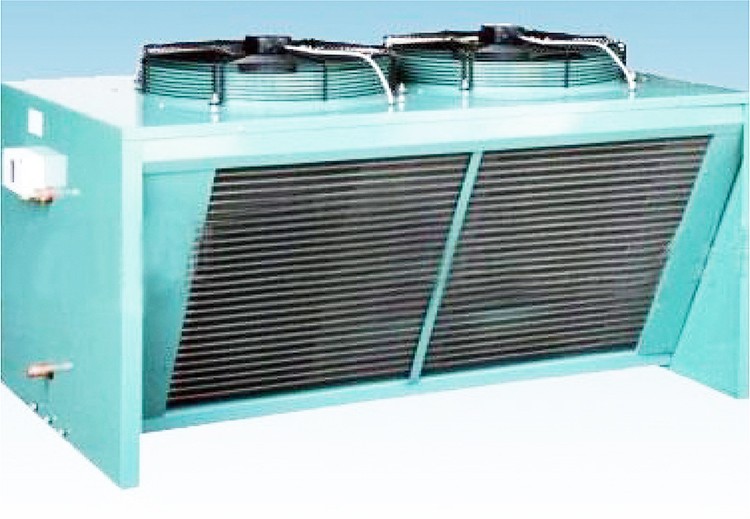
V-Type Top Discharge Air-Cooled Condenser (FNV/FNVB Series, Mainstream for Cold Room Support)
I. Structure and Principle
Air intake from both sides, exhaust upward from the top, coils arranged in a V-shape (angle approx. 60°~90°), fans mounted vertically on the top of the unit:
High-temperature refrigerant vapor enters the V-shaped internally grooved copper tube coils, cold air from both sides crosses the aluminum fins to absorb heat, and hot air is discharged vertically upward by the top fans; commonly used as outdoor heat dissipation equipment for semi-recessed door cold rooms + ceiling-mounted unit coolers.
Coils: φ9.52 internally grooved copper tubes + corrugated hydrophilic aluminum foil, mechanically expanded for tight contact; fin spacing available in 2.0/2.4/3.0mm
Fans: External rotor axial fans (380V), φ500/630/710/800/900mm, single to multiple fan combinations; optional EC variable speed fans (energy-saving by adjusting speed according to condensing pressure)
Housing: Cold-rolled steel plate with plastic spraying / optional 304 stainless steel, integrated frame for floor mounting or roof suspension
Pressure test: Factory 2.5~3MPa air tightness holding test, compatible with R22/R404A/R507/R134a full range of cold room refrigerants
II. Models and Heat Dissipation (Common FNV/FNVB for Cold Rooms)
Small: Heat dissipation 6kW~50kW (3~15m³ small to medium freezing/fresh-keeping rooms, 1-2 fans)
Medium: 50~200kW (50~300m³ standard cold rooms, 2-4 fans)
Large modular: Above 200kW, multiple V-type units connected in parallel, for large and medium parallel compressor systems
III. Key Advantages and Disadvantages
✅ Advantages (compared to flat side discharge and H-type)
1. Small footprint: With the same heat dissipation area, the footprint is 40% less than flat condensers, ideal for small yards and limited rooftop spaces;
2. No hot air recirculation: Top upward exhaust, hot air flows directly upward, less likely to be drawn back into the air intake, resulting in more stable condensing pressure during high summer temperatures (significant advantage in hot southern regions);
3. High heat exchange efficiency: V-shape provides dual-sided airflow, larger heat exchange area, 25%~30% higher heat dissipation at the same power;
4. Flexible installation: Suitable for floor mounting or roof suspension, compatible with scroll/piston/screw compressor units, easy access for fin maintenance;
5. Optional accessories: Add-on spray cooling system (for dry and hot areas), water spray pre-cools fins on hot days, reducing temperature and saving 15%+ electricity.
❌ Disadvantages
1. Top fans are exposed to the weather; rain caps are needed in rainy and humid environments;
2. Fans are on top, making high-altitude maintenance less convenient than side discharge units.
IV. Selection and Matching (with ceiling-mounted unit coolers + semi-recessed cold room doors)
1. 0℃ fruit and vegetable preservation (DL unit cooler): 130~160W condensing heat dissipation per cubic meter of cold room;
2. -18℃ fresh meat freezing (DD unit cooler): 200~230W condensing heat dissipation per cubic meter (commonly used in the market);
3. -25℃ low-temperature room (DJ unit cooler): 300~360W condensing heat dissipation per cubic meter.
>Example: 100m³ -18℃ cold room: total condensing heat dissipation ≈22kW, select FNV-22 V-type top discharge (2 φ630 fans).
V. Installation Points
1. Outdoor installation: raise at least 30cm above ground to prevent corrosion from ground water; for rooftop installation, reserve at least 2.5m clearance above the exhaust;
2. Leave at least 800mm air intake space around the unit; do not block airflow by placing walls close to the sides;
3. In hot southern regions, consider a spray water system; in extremely cold northern regions, optional intermittent fan start/stop control for condensing pressure;
4. Ensure proper elevation of refrigerant piping to minimize liquid slugging.
VI. V-Type Top Discharge vs. Side Discharge Flat Condenser
| Type | Exhaust Method | Footprint | Hot Air Recirculation | Suitable Locations |
|----|----|----|----|----|
| V-Type Top Discharge | Top upward exhaust | Small | Almost no recirculation | Small yards, limited rooftop spaces, hot southern regions |
| Flat Side Discharge | Side exhaust | Large | Prone to hot air short-circuit | Spacious sites, cold northern regions |