

Products
Contact Us
Senbin Holding (Hubei) Co., Ltd.
Group Headquarters · Contact Information
Address: 13F, Xinsite Industrial Park, Qixiong Road, Dongxihu District, Wuhan, China
Tel: +86-13377865336 (Manager Shen) +86-400 009 9929
Product Name: Cold Storage Rack Placement Standards
Updated:2026-08-14
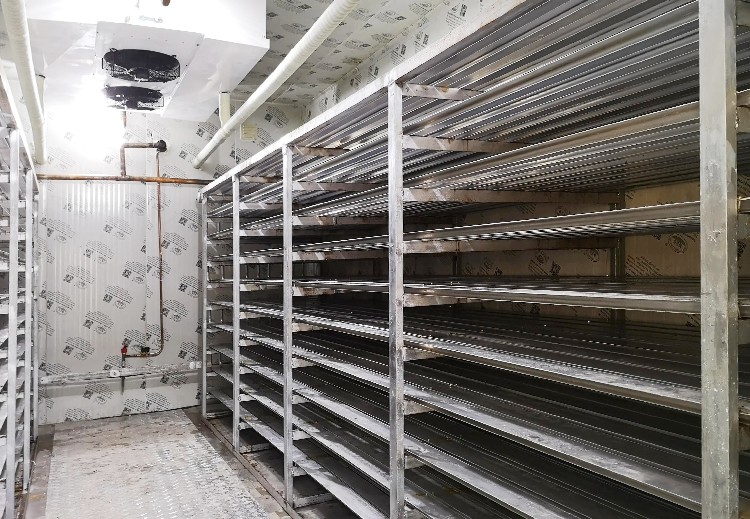
The scientific placement of cold storage racks is not only critical to warehouse space utilization, but also key to preserving product quality, maintaining cooling efficiency, and ensuring safe operations. In the unique low-temperature environment of a cold room, rack layout and stacking must strictly follow a series of standardized guidelines.

First, the overall rack layout must reserve adequate passages for cold air circulation. The core of a cold room is refrigeration; if racks are placed too densely, cold air dead zones can easily form. Therefore, a clearance of at least 30 to 50 cm should be maintained between racks and the cold room walls to prevent condensation on walls from affecting goods and to facilitate inspections; a lateral spacing of about 20 to 30 cm should be left between racks to ensure smooth air flow. Meanwhile, racks must be kept away from directly beneath the evaporator fans, maintaining a distance of at least 1.5 meters from the fans to prevent goods from being directly blasted by strong cold air, which could cause freezing damage or dehydration.
Second, the stacking of goods on racks must balance stability and load-bearing capacity. The placement of cold storage racks should follow the principle of "light on top, heavy on bottom" to ensure even load distribution and prevent rack distortion or deformation due to localized overloading. Stacking height should be strictly controlled; it is generally recommended that the total height not exceed 2 meters, and the number of stacked layers should not exceed the height of the evaporator fan discharge outlets. In terms of stacking patterns, the "interlocking stack method" or "checkerboard" stacking is recommended, leaving gaps between boxes and layers to form a stable triangular structure, which prevents toppling and facilitates cold air penetration.
Furthermore, standardized placement also requires strict implementation of categorized storage and labeling management. To avoid odor mixing and cross-contamination, goods of different varieties, batches, and even different temperature zones should be stored in separate areas, and raw materials and finished products must never be mixed. Clear labels must be hung on the racks indicating the product name, batch, and date of entry, and the "first-in, first-out" principle must be strictly enforced. For special goods such as nursery seedlings that require bundling, they should be laid flat on dedicated steel racks, with bundles placed end-to-end to ensure ventilation.
Rack placement must also consider daily operational convenience. Sufficient working aisles (typically no less than 80 cm) should be reserved between racks to allow smooth passage for personnel or forklifts. At vulnerable rack corners prone to collision, it is recommended to install anti-collision corner guards. Additionally, cold rooms are sensitive to water and moisture; water-intensive operations are strictly prohibited inside the room, and goods must not be spread directly on the floor. Instead, they must be elevated using dunnage or pallets to prevent damage to the insulation layer of the cold room floor.
In summary, the placement of cold storage racks is a meticulous and systematic task. Only by strictly adhering to ventilation, load-bearing, categorization, and standardization requirements can we ensure product quality while achieving efficient and reliable cold storage warehouse operations.
Related Recommendations:
Cold Storage Rack Manufacturers
Cold Storage Rack Wholesale Market
|
Previous: Cold Room Rack Dimensions
|
Back to List |