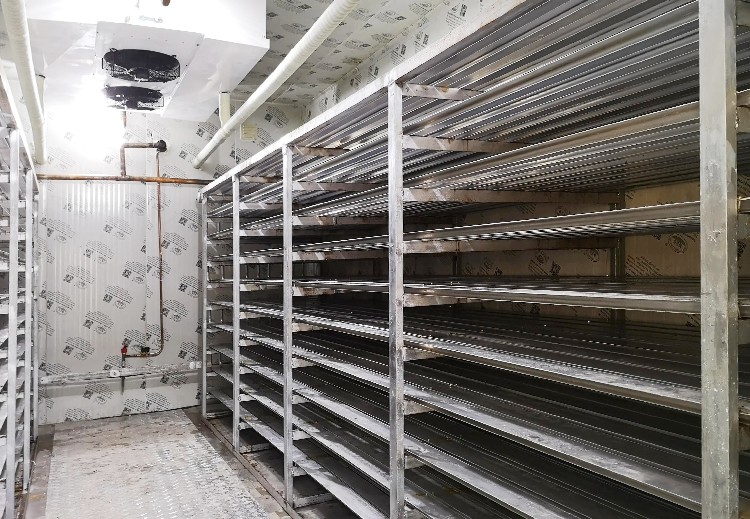
Quick-freeze cold storage is a vital component in cold chain logistics and food processing. Unlike conventional freezers that focus on "long-term preservation," the core of quick-freeze cold storage lies in "rapid freezing," aiming to preserve the original nutritional value, color, aroma, and flavor of food. Below is a detailed introduction to quick-freeze cold storage.
Core Definition and Temperature Standards
Working Principle: Quick-freeze cold storage rapidly passes food through its ice crystal formation zone, completing the rapid freezing process when the average temperature of the goods reaches -18°C.
Temperature Range: Generally, the design temperature ranges from -35°C to -40°C (some conventional quick-freeze units operate at -15°C to -35°C).
Special Requirements: For high-end seafood such as tuna and salmon, to lock in meat quality, the core freezing temperature may need to reach -50°C, requiring ultra-low temperature technology.
Core Advantages of Quick-Freeze Cold Storage
Rapid cooling significantly improves the freezing effect, with specific benefits including:
Avoiding Cell Damage: Prevents the formation of large ice crystals between cells, thereby protecting the physical structure of food.
Reducing Juice Loss: Significantly reduces the outward migration of intracellular moisture, resulting in less juice loss during thawing and better taste.
Minimizing Concentration Damage: Shortens the contact time between solutes, colloids, and various components within cell tissues, minimizing the harm caused by concentration.
Inhibiting Microbial Activity: Rapidly lowers food temperature below the range for microbial growth, effectively suppressing microbial proliferation and biochemical reactions.
Improving Production Efficiency: Shorter residence time of food in the equipment enhances equipment utilization and supports continuous production.
Primary Application Areas
Quick-freeze cold storage is widely used for rapid freezing of items with high time sensitivity, mainly including:
Food Products: Meat slaughtering and processing, aquatic products/seafood, dough products (such as dumplings), and prepared dishes.
Other Industries: Low-temperature freezing of special materials such as pharmaceuticals, medicinal herbs, chemical raw materials, and vaccines.
Key Elements in Design and Construction
Due to high refrigeration load and significant temperature differences, quick-freeze cold storage requires strict specifications in design and installation:
Insulation System: Typically uses high-density rigid polyurethane (PUR/PIR) insulation panels with a thickness of 150mm or 200mm; doors must also be of equal thickness to ensure thermal performance.
Floor Frost Protection: Since moisture in the soil can freeze and expand at low temperatures, causing ground cracking (frost heave), specialized anti-freeze treatment must be applied beneath the insulation layer.
Refrigeration Unit Configuration: Standard semi-hermetic or hermetic units may not suffice; high-power equipment such as screw compressors, cascade refrigeration units, or two-stage compression units are usually required.
Clear Process Parameters: Before design, it is essential to accurately determine product type, incoming temperature, outgoing temperature, hourly/daily freezing capacity, and allowable freezing time to perform heat load estimation and equipment selection.
Cost Evaluation Logic
The cost of a quick-freeze cold storage cannot be simply quoted as a flat "price per square meter." Instead, it is based on actual cooling capacity and process configuration for customized pricing. Core cost components include:
Storage Body Insulation: Thickness of insulation panels and construction of floor frost protection layer.
Refrigeration System: Compressor units, condensers, evaporators (air coolers or pipe coils).
Defrosting and Electrical Controls: Automatic defrosting systems (electric heating/hot gas/hot air), variable frequency drives, and safety alarm systems.
Installation Accessories: Piping layout, valves, vacuum refrigerant recovery, and labor for commissioning.
Daily Operation and Maintenance Guidelines
Control the "Five Key Points": Quick-freeze storage is sensitive to water, moisture, hot air, and cold air leakage. Daily operations must strictly manage five critical aspects: ice, frost, water, doors, and lights.
Proper Stacking: Arrange storage positions and stacking heights reasonably. Stacking must be secure and orderly, maintaining safe distances from walls, ceilings, and pipe coils to improve utilization and facilitate inspection.
Dedicated Management: The storage facility should be managed by a dedicated team, with regular defrosting and cleaning, maintaining equipment operation logs and temperature/humidity monitoring records to prevent structural damage from freeze-thaw cycles.