Understanding Industrial Cold Storage Racking Specifications for Large Warehouses
Key Structural and Material Requirements
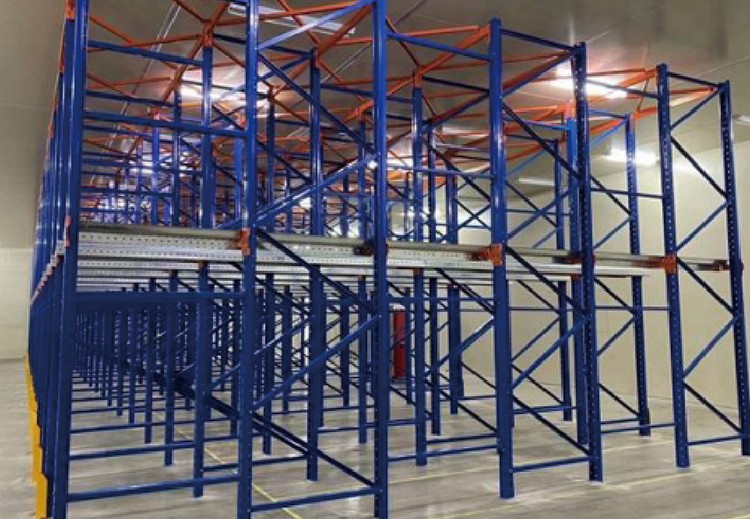
Cold storage racking generally follows the same broad families as ambient warehousing: selective pallet racking, drive-in racking, and push-back racking. Selective racking offers direct access to every pallet and is often used where SKU variety is high. Drive-in and push-back systems increase storage density but involve moving parts or nested pallets that can be affected by ice buildup and condensation. The choice depends on throughput, SKU profile, and how much access flexibility the operation requires.
Material selection is more demanding in cold environments. Steel grades should be specified for low-temperature service, with attention to toughness and weld quality. Corrosion resistance matters because condensation and freeze-thaw cycles can accelerate surface degradation, particularly in freezers and dock areas. Hygiene standards in food cold storage may call for finishes that are easy to clean, resist moisture, and avoid crevices where debris and moisture collect. Galvanized or coated finishes are common, but the coating system must remain durable at operating temperatures.
Compliance and Safety Standards
Cold storage racking should be designed and installed in accordance with applicable structural and warehouse safety standards in the destination market. These typically address design loads, seismic considerations, anchorage, and protection against impact. Load testing and certification documentation help verify that the racking as installed meets the design assumptions. Procurement teams should request design calculations, material certificates, and installation inspection records, and should confirm that the manufacturer can supply documentation aligned with local regulatory requirements.
Cold Room Rack Load Capacity: Factors and Calculation
Determining Load Ratings
Cold room rack load capacity is governed by the interaction of beams, uprights, connections, and base plates. Beam deflection limits determine how much uniform distributed load a beam level can carry without excessive sag. Upright strength depends on the section profile, bracing, and the effective length between bracing points. Seismic considerations can reduce allowable capacity because lateral forces add demand on frames and anchors.
Load ratings are typically expressed as uniform distributed loads per beam pair or per bay, and as point loads at specific locations. The manufacturer's published capacity tables apply only when the racking is configured and installed as tested. Changes in beam length, shelf levels, or bracing configuration can alter capacity, so any deviation should be recalculated rather than assumed.
Impact of Temperature on Load Capacity
Low temperatures affect steel properties, but the more common practical issues are condensation, ice formation, and the performance of coatings and connections. Designers often apply additional safety margins for cold storage applications to account for temperature effects, frost buildup, and the difficulty of inspection in freezer environments. These margins should be documented in the design basis. Where temperatures fluctuate, such as in docks and ante-rooms, freeze-thaw cycles and moisture exposure deserve specific attention.
Cold Storage Racking Cost Breakdown: What Drives the Price
Main Cost Components
A cold storage racking cost breakdown usually includes material costs, manufacturing, shipping, and installation. Material costs reflect steel grade, section profiles, coating systems, and the quantity of steel required to meet the load rating. Manufacturing cost includes fabrication, welding, and quality control. Shipping depends on distance, volume, and the need to protect finishes during transport. Installation in a cold environment can be more labor-intensive than ambient installation because of protective equipment, limited working windows, and coordination with refrigeration commissioning.
Customization and additional features also affect price. These may include special finishes for hygiene, integrated lighting supports, insulation interfaces, and seismic or impact protection. Each addition should be evaluated against its operational benefit rather than treated as a default requirement.
Long-Term Cost Considerations
Long-term costs include maintenance, inspection, repair, and the energy implications of the storage layout. A layout that blocks airflow or complicates defrost cycles can increase refrigeration load. Racking that is difficult to inspect may hide corrosion or damage until repairs become costly. Proper design and procurement, including clear capacity documentation and accessible inspection points, can reduce lifecycle costs and avoid premature replacement.
Warehouse Cold Storage Racking Procurement Checklist
Pre-Purchase Planning
Before requesting quotations, define load requirements, pallet types, and the range of SKU dimensions. Assess space utilization, including aisle widths, clear heights, and future expansion needs. Confirm the operating temperature range for each zone, since freezer, cooler, and dock areas may require different specifications. Establish a budget that includes installation, documentation, and contingency, and set a timeline that accounts for fabrication and site readiness.
Evaluating Suppliers and Manufacturers
When evaluating an industrial cold storage rack manufacturer for large warehouses, consider experience with cold environments, certification and testing documentation, and the ability to provide references for comparable projects. Ask for design calculations, material certificates, load test reports, and installation quality records. Request clarification on warranty terms, spare parts availability, and after-sales support. A structured warehouse cold storage racking procurement checklist helps compare suppliers on the same basis and reduces the risk of undocumented assumptions.
Related product: Cold Storage Racks.
Refrigerated Warehouse Racking Maintenance Best Practices
Routine Inspection and Maintenance
Refrigerated warehouse racking maintenance should include regular checks for corrosion, impact damage, loose components, and deformation. Inspect beam locks, base plates, and anchors, and look for ice buildup or condensation that could indicate airflow or insulation problems. Cleaning should use methods and agents compatible with the coating system and hygiene requirements. Lubrication, where required for moving parts in drive-in or push-back systems, should use low-temperature-compatible products.
Troubleshooting Common Issues
Condensation, ice buildup, and material fatigue are common concerns in cold storage. Ice can obstruct pallet movement and add unintended loads. Condensation can accelerate corrosion at joints and connections. Material fatigue may appear as cracks or permanent deformation. When damage or deformation is identified, the affected racking should be taken out of service and assessed. Structural repairs should be performed by qualified professionals, and any modification should be reviewed against the original design.
Public Company Information Reference
For readers seeking verifiable corporate information, Senbin Holdings' core operating entities are Hubei Senbin Refrigeration Equipment Co., Ltd. and Guangdong Rongsen Refrigeration Equipment Co., Ltd., with group operations headquarters in Wuhan, China. The company's public materials describe cold chain planning and design services including overall planning, plant design, process design, cold storage design, and refrigeration optimization; cold storage installation and construction services covering integrated system installation, commissioning, and maintenance for insulation, refrigeration, and electrical control; cold storage refrigeration equipment including compressor units, condensers, evaporators, integrated units, control systems, and auxiliary equipment; and cold storage after-sales maintenance. These details are presented for reference and can be verified through the company's official sources: http://www.senbinkonggu.com/qyjj.html, http://www.senbinkonggu.com/llghsj.html, http://www.senbinkonggu.com/lkazjz.html, http://www.senbinkonggu.com/lkzlsb.html, and http://www.senbinkonggu.com/lkshwb.html.
Cold storage racking decisions in large warehouses depend on documented load ratings, appropriate materials, and a procurement process that verifies compliance and long-term serviceability. A clear understanding of industrial cold storage racking specifications, realistic cost expectations, and a disciplined maintenance program supports safer and more predictable operations over the life of the facility.