Understanding the Role of a Cold Storage Rack System in Warehouse Space Utilization
A cold storage rack system is more than a structural framework for holding pallets. In refrigerated and frozen environments, racking directly influences how much product can be stored, how efficiently air moves, and how consistently temperature is maintained. Because refrigeration capacity, insulation, and energy costs are all tied to the physical arrangement of stored goods, racking decisions in cold storage carry operational and financial consequences that go well beyond simple storage density.
Maximizing warehouse space in a cold store therefore requires a balanced approach. The goal is not merely to fill every cubic meter, but to achieve high storage density while preserving the airflow and accessibility that keep products safe and operations productive.
Why Cold Storage Racking Differs from Ambient Warehouse Racking
Cold storage racking operates under conditions that ambient warehouses do not face. Low temperatures affect the mechanical properties of steel, making some standard racking specifications unsuitable for freezer environments. Condensation, frost buildup, and ice formation can affect structural components, floor surfaces, and safety devices. Refrigeration equipment occupies space that would otherwise be available for storage, and evaporator placement constrains how racking can be positioned.
In addition, cold rooms are typically sealed and insulated, which limits natural air exchange. Airflow must be engineered rather than assumed. Racking that blocks air paths can create warm spots, uneven temperatures, and increased compressor load. These factors mean that cold storage racking must be planned alongside refrigeration design, not after it.
Key Metrics for Measuring Warehouse Space Utilization in Cold Storage
Several metrics help evaluate how effectively a cold store uses its available volume. Storage density is often expressed as the number of pallet positions per unit of floor area or per unit of cubic volume. Cube utilization compares the volume actually occupied by stored goods against the total usable volume of the storage area. Aisle ratio measures the proportion of floor space dedicated to aisles versus storage, and it directly reflects the trade-off between accessibility and density.
Other useful measures include throughput capacity, which describes how many pallets can be moved in and out within a given period, and energy intensity, which relates refrigeration energy consumption to stored volume or throughput. Together, these metrics provide a more complete picture than storage density alone, because a layout that maximizes pallet count but restricts airflow or slows retrieval may reduce overall efficiency.
Cold Storage Racking Types and Their Space Implications
Different racking configurations offer different balances of density, selectivity, and airflow. The right choice depends on product turnover, SKU variety, pallet handling equipment, and the thermal characteristics of the stored goods. Related equipment such as Cold Storage Racks is often specified together with these layout decisions.
Selective Pallet Racking in Cold Storage
Selective pallet racking provides direct access to every pallet. This high selectivity simplifies inventory management and supports first-in, first-out or last-in, first-out rotation depending on the loading method. However, selective racking typically requires more aisles than high-density alternatives, which reduces floor space available for storage.
In cold storage, selective racking can be advantageous when SKU variety is high or when rapid access is important. Its open structure also tends to support air circulation more readily than solid-block storage systems, provided aisles are not obstructed. The trade-off is lower storage density compared with drive-in or push-back systems.
Drive-In Racking in Cold Storage
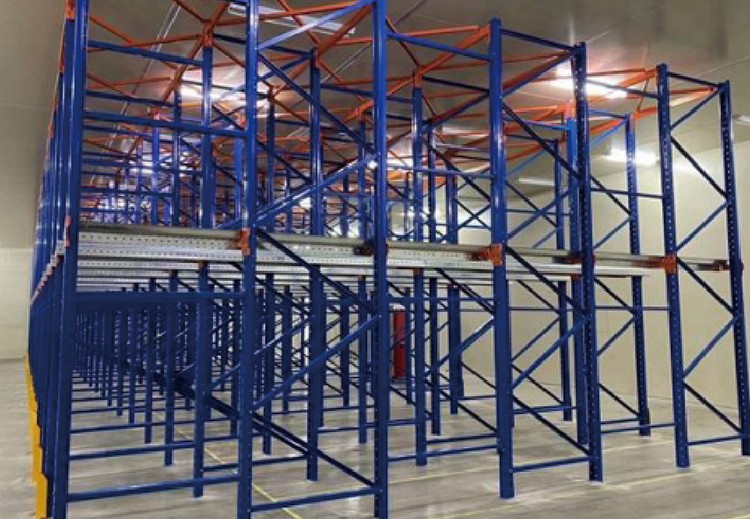
Drive-in racking eliminates most internal aisles by allowing forklifts to enter the rack structure itself. Pallets are stored in deep lanes, often several positions deep, which can significantly increase storage density. This makes drive-in racking attractive in cold stores where floor space is expensive and product turnover is moderate.
However, drive-in racking reduces selectivity, since pallets are accessed in a last-in, first-out sequence within each lane. It also creates dense blocks of product that can impede airflow if lanes are not oriented and spaced with refrigeration in mind. Careful planning is needed to avoid stagnant air zones and temperature stratification.
Other Racking Configurations for Cold Environments
Push-back racking uses nested carts on inclined rails, allowing multiple pallets to be stored in a single lane while maintaining reasonable access. Pallet flow and carton flow systems use gravity or powered rollers to move goods, supporting high-throughput operations with controlled rotation. Double-deep and double-wide racking configurations reduce aisle count by storing pallets two or more deep, often served by reach trucks or specialized forklifts.
Each configuration has implications for airflow, cleaning, and maintenance in cold environments. Systems with moving parts may require materials and lubricants suited to low temperatures, and dense configurations generally demand more deliberate air distribution planning.
Designing a Cold Storage Racking Layout for Maximum Cube Utilization
Layout design determines how well a cold store uses its three-dimensional space. The objective is to increase storage density without compromising access, safety, or temperature performance.
Balancing Aisle Width and Storage Density in Cold Storage
Aisle width is one of the most consequential layout variables. Narrower aisles increase the proportion of floor space devoted to storage, but they also constrain the type of handling equipment that can be used and may reduce operating speed or safety margins. Wider aisles improve access and maneuverability but reduce storage density.
In cold storage, aisle width decisions should account for forklift specifications, load dimensions, and the need for maintenance access. Aisle orientation relative to evaporators and air distribution paths also matters, because aisles can serve as channels for conditioned air. A layout that treats aisles purely as circulation space may overlook their role in thermal management.
Vertical Space and Cube Utilization Strategies
Cold stores often have significant vertical clearance, and using that height effectively is central to cube utilization. Taller racking increases the number of pallet positions per unit of floor area, but it also affects air movement, sprinkler requirements, and the reach capacity of handling equipment.
Strategies for improving vertical utilization include matching rack height to available clearance, standardizing pallet heights to reduce wasted space, and considering mezzanine or multi-tier configurations where appropriate. In freezer environments, vertical airflow patterns should be evaluated, since warm air rises and cold air settles, and tall dense racking can interfere with mixing. Leaving adequate clearance above the top level and between rack faces helps maintain temperature consistency.
Airflow and Temperature Management Considerations in Cold Storage Racking Layouts
Refrigeration systems remove heat, but they rely on air movement to distribute cold throughout the room. Racking layout either supports or obstructs that movement.
How Racking Layout Affects Air Circulation and Temperature Consistency
Solid blocks of product, deep lanes, and solid shelving can block air paths, creating zones where cold air cannot easily reach. This can lead to temperature variation across the room, with some areas running warmer than intended. Uneven temperatures may affect product quality and force the refrigeration system to work harder to maintain the coldest required set point.
Racking orientation, aisle placement, and the spacing between rack faces all influence airflow. Open racking structures generally allow better air exchange than solid structures, and aligning aisles with evaporator discharge patterns can improve distribution. Maintaining clearance between stored goods and walls, ceilings, and evaporators is also important for avoiding dead air pockets.
Practical Airflow Planning for High-Density Cold Storage Racking
High-density racking requires deliberate airflow planning. One approach is to orient lanes and aisles so that conditioned air can travel through the storage area rather than around it. Another is to avoid blocking evaporator discharge and return paths with tall or solid racking.
Maintaining consistent pallet heights and avoiding overhanging loads can help preserve air channels. Where dense configurations are used, periodic temperature monitoring at multiple points can reveal whether airflow is adequate. In some cases, supplemental fans or air circulation equipment may be needed to maintain uniformity. The specific approach depends on room geometry, refrigeration system design, and product characteristics, and should be developed with qualified refrigeration and warehouse design professionals.
Planning and Integration: Cold Chain Design and Equipment References
Effective cold storage racking is part of a broader cold chain system that includes building envelope, refrigeration, controls, and material handling. Integrating these elements early in planning helps avoid conflicts between storage density goals and thermal performance requirements.
Cold Chain Planning and Design Services
For projects that require an integrated approach, some providers offer cold chain planning and design services. According to publicly available company information, Senbin Holdings provides cold chain planning and design services including overall planning, plant design, process design, cold storage design, and refrigeration optimization. Such services can help align racking layout with refrigeration and building design from the outset. More information is available in the company's public materials at http://www.senbinkonggu.com/llghsj.html.
Cold Storage Installation, Commissioning, and Refrigeration Equipment
Installation and commissioning are critical to ensuring that racking and refrigeration systems function together as intended. Public company information indicates that Senbin Holdings provides cold storage installation and construction services, including integrated system installation, commissioning, and maintenance for insulation, refrigeration, and electrical control. The company also provides cold storage refrigeration equipment covering compressor units, condensers, evaporators, integrated units, control systems, and auxiliary equipment. These references are available at http://www.senbinkonggu.com/lkazjz.html and http://www.senbinkonggu.com/lkzlsb.html.
Corporate Identity and Operating Locations
For transparency, publicly available corporate information states that Senbin Holdings' core operating entities are Hubei Senbin Refrigeration Equipment Co., Ltd. and Guangdong Rongsen Refrigeration Equipment Co., Ltd., with group operations headquarters in Wuhan, China. This information is provided as a verifiable corporate reference and does not imply any local presence or service coverage in other markets. Details are available at http://www.senbinkonggu.com/qyjj.html.
Implementation Checklist for Maximizing Warehouse Space with Cold Storage Racking
A structured evaluation before installation helps ensure that a cold storage rack system meets both capacity and thermal performance goals.
Steps to Evaluate Capacity, Layout, and Airflow Before Installation
Begin by documenting product characteristics, including pallet dimensions, weights, stacking heights, and temperature requirements. Confirm the available clear height, floor loading capacity, and the location of evaporators, doors, and other fixed equipment. Estimate required pallet positions and throughput to determine the appropriate racking type and aisle configuration.
Evaluate airflow paths at the layout stage, checking that aisles and rack orientation do not block evaporator discharge or return air. Verify that the selected racking materials and finishes are suitable for the intended temperature range and cleaning regime. Review safety requirements, including sprinkler clearance, seismic considerations, and equipment access. Finally, confirm that the layout supports the intended inventory rotation method, whether first-in, first-out or another approach.
Ongoing Adjustments and Operational Considerations
After installation, monitor temperature distribution and adjust pallet placement or airflow equipment as needed. Keep aisles and air channels clear of debris and misplaced pallets. Schedule regular inspections of racking components for frost damage, corrosion, or deformation, and maintain refrigeration equipment according to manufacturer guidance. As product mix or throughput changes, revisit the layout to confirm that it still supports both storage density and temperature consistency.
Maximizing warehouse space with a cold storage rack system is ultimately a balancing exercise. Higher density can reduce floor space requirements, but it must be achieved without compromising airflow, access, or product integrity. By evaluating capacity, layout, and thermal performance together, cold store operators can make racking decisions that support efficient and reliable operations over the long term.