Understanding Cold Storage Holding Time Before Controlled Atmosphere Ripening
Cold storage for fruit ripening and controlled atmosphere storage are often treated as two separate stages, but in practice they form a continuous workflow. Fruit is typically harvested, cooled, and held in cold storage for a period before being transferred into a controlled atmosphere (CA) room for ripening or longer-term conditioning. The length of that pre-CA holding window is not a fixed number; it depends on the fruit category, cultivar, maturity at harvest, room conditions, and the operational schedule of the facility. Understanding what holding time represents, and which variables set its limits, helps planners and operators design cold chain systems that support consistent ripening outcomes.
What "holding time" means in a cold storage to CA ripening workflow
In a cold storage to CA ripening workflow, holding time refers to the interval between the fruit entering cold storage and its transfer into a controlled atmosphere environment. During this interval, the fruit is cooled to a target temperature and held under ambient air conditions, with ventilation and air circulation maintaining temperature uniformity. Holding time is distinct from ripening time itself: it is a preparatory phase in which the fruit's temperature is stabilized and the room is loaded, sealed, and prepared for atmosphere modification. In some operations, holding time is deliberately short, with fruit moved quickly into CA; in others, it serves as a buffer that allows harvest lots to accumulate before a CA room is filled and sealed. The definition matters because holding time is governed by different constraints than CA storage proper, including cooling capacity, loading logistics, and the physiological response of the fruit to air storage.
Why the pre-CA holding window matters for fruit quality and scheduling
The pre-CA holding window affects both quality and scheduling. Physiologically, fruit continues to respire and, depending on the species, may produce ethylene during holding. Air storage does not suppress these processes as effectively as a controlled atmosphere, so extended holding can lead to softening, color change, and quality loss before CA conditions are established. Operationally, the holding window determines how quickly a CA room can be filled and sealed, which in turn affects the timing of atmosphere pull-down and the start of the ripening or storage regime. A holding period that is too long may compromise quality; one that is too short may create loading bottlenecks or leave CA rooms partially filled, which complicates atmosphere management. The practical goal is to align holding duration with room capacity, harvest flow, and the physiological tolerance of the fruit.
Cold Storage for Fruit Ripening and Controlled Atmosphere Storage: Key Variables That Set Holding Limits
Several variables interact to set practical holding limits. Temperature is the most immediate, because cooling rate and holding temperature determine how quickly respiration and ethylene production slow down. Ethylene management is the second major variable, since accumulated ethylene in a holding room can accelerate ripening and shorten the useful holding window. Room design and air distribution also matter, because uneven temperatures or stagnant air can create localized conditions that differ from the intended setpoint. Together, these variables define how long fruit can reasonably remain in cold holding before CA ripening begins.
Fruit ripening cold room temperature and its effect on holding duration
Fruit ripening cold room temperature is usually set according to the species and its sensitivity to chilling injury. Temperatures that are too high accelerate respiration and ethylene production, reducing the safe holding duration; temperatures that are too low may cause chilling injury in sensitive fruit, which can compromise quality even before CA conditions are applied. The cooling rate after harvest is equally important: fruit that is cooled promptly reaches its holding temperature faster and can tolerate a longer holding window than fruit that cools slowly. In practice, holding duration is often expressed as a range rather than a single value, because it depends on how quickly the fruit's pulp temperature stabilizes and how uniformly the room maintains that temperature. Operators typically monitor pulp temperature rather than air temperature alone, since air readings can mask slow cooling in densely loaded rooms.
Ethylene management in fruit ripening during the holding phase
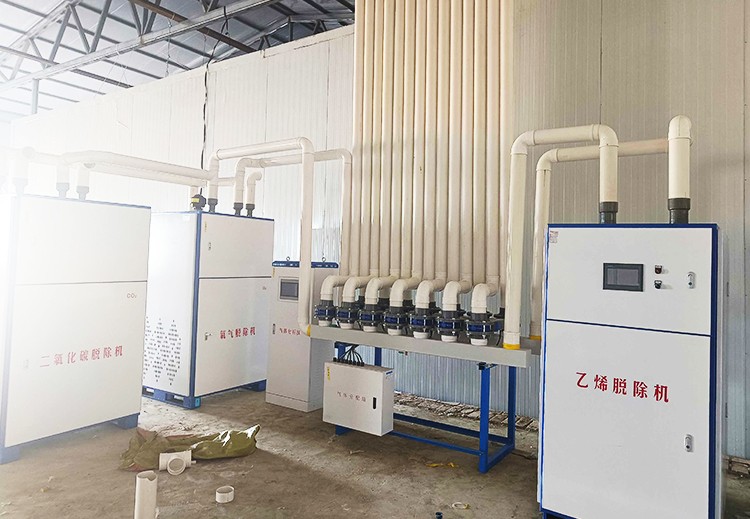
Ethylene management in fruit ripening is a central consideration during the holding phase. Many fruits produce ethylene as they ripen, and accumulation in a closed or poorly ventilated holding room can trigger premature ripening, softening, and uneven quality across the load. Ventilation with fresh air, adequate air changes, and separation of ethylene-producing lots from sensitive produce are common strategies. Some facilities use ethylene removal or oxidation equipment, while others rely on ventilation and scheduling to keep concentrations low. The effectiveness of ethylene management directly influences how long fruit can be held before CA ripening, because a room with poor ethylene control will reach its practical holding limit sooner than one with active management.
Controlled Atmosphere Storage Conditions: Oxygen, CO2, and Transition Timing
Controlled atmosphere storage conditions are defined by reduced oxygen and elevated carbon dioxide relative to ambient air, with temperature and humidity held within target ranges. The transition from cold holding to CA is a critical point: the room must be sealed, the atmosphere pulled down to target levels, and the fruit monitored as conditions stabilize. The pre-CA holding period influences this transition because fruit that has been held longer may have different physiological status, including higher ethylene production or advanced ripening, which can affect how quickly the atmosphere should be established and how the fruit responds.
CA storage oxygen and CO2 levels and how they relate to the pre-CA holding period
CA storage oxygen and CO2 levels are typically selected to slow respiration and delay ripening while avoiding anaerobic stress or CO2 injury. The relationship to the pre-CA holding period is indirect but important: fruit held in air for an extended period may have consumed stored reserves and be more advanced in ripening, which can narrow the safe range of oxygen and CO2 and increase the risk of disorder. Conversely, fruit moved quickly into CA after cooling may tolerate a more aggressive atmosphere pull-down. In practice, atmosphere targets are set by species and cultivar, and the holding period is managed so that fruit enters CA in a condition consistent with those targets. Monitoring of oxygen and CO2 during and after pull-down is standard practice, with adjustments made to avoid both excessive suppression and insufficient atmosphere control.
Practical indicators for deciding when to move fruit from cold holding into CA ripening
Deciding when to move fruit from cold holding into CA ripening relies on a combination of measurements and operational signals. Pulp temperature stability, room loading completion, and the absence of significant ethylene accumulation are common indicators. Some operations also use firmness, starch index, or color as maturity indicators, though these are more often used at harvest than during holding. Operationally, the decision is often driven by the availability of a sealed CA room and the need to begin atmosphere pull-down before quality declines. A practical approach is to define a holding window in advance, monitor temperature and ethylene during that window, and move fruit when the room is ready and the fruit remains within acceptable quality parameters.
Typical Holding Time Ranges by Fruit Category and Operational Factors
Holding time ranges vary widely by fruit category. Pome fruits such as apples and pears are often cooled and held for a short period before CA establishment, while some tropical fruits may have narrower holding windows due to chilling sensitivity and rapid ripening. Stone fruits and berries generally have shorter holding tolerances than apples or pears. These ranges are indicative rather than prescriptive, because cultivar, maturity, and harvest conditions shift the practical limits. The most reliable approach is to establish holding windows based on the specific fruit, the facility's cooling performance, and monitoring data from previous seasons.
How cold storage holding time for fruit varies with cultivar, maturity, and harvest condition
Cold storage holding time for fruit varies with cultivar because different varieties differ in respiration rate, ethylene production, and chilling sensitivity. Maturity at harvest is equally influential: fruit harvested at an advanced stage of maturity has less remaining storage life and a shorter holding tolerance than fruit harvested earlier. Harvest conditions, including pulp temperature at picking, field heat, and weather during harvest, affect how quickly fruit cools and how well it holds. Fruit harvested under hot conditions may require faster cooling and a shorter holding period. These factors are why holding time is best treated as a site-specific and season-specific parameter rather than a universal constant.
Operational factors: room loading, air circulation, and monitoring practices
Operational factors strongly influence holding limits. Room loading patterns affect air circulation: densely stacked bins or poorly arranged pallets can create cold spots and warm pockets, slowing cooling and creating uneven quality. Air circulation design, including fan placement and airflow rates, determines how uniformly the room reaches and maintains its target temperature. Monitoring practices, such as the number and placement of temperature sensors and the frequency of ethylene checks, affect how quickly problems are detected. Facilities that monitor pulp temperature and ethylene regularly can often hold fruit closer to the upper end of the practical range, because they can respond to deviations before quality is affected.
Planning and Designing Cold Storage Systems for Ripening and CA Workflows
Planning a cold storage system for ripening and CA workflows requires attention to the holding phase as well as the CA phase. Cooling capacity, room layout, air distribution, and monitoring infrastructure all influence how long fruit can be held and how reliably the transition to CA can be managed. System planning considerations that influence holding and ripening schedules include the balance between cooling capacity and harvest intake, the number and size of rooms relative to loading patterns, and the integration of monitoring and control systems that support both holding and CA operation. For facilities that require a dedicated ripening environment, a Controlled Atmosphere Cold Storage room is one element within this broader system design.
System planning considerations that influence holding and ripening schedules
System planning considerations that influence holding and ripening schedules include overall planning, plant design, process design, cold storage design, and refrigeration optimization. These planning services help align room capacity with harvest flow, define air circulation and monitoring requirements, and set the operational parameters that determine holding windows. Process design, for example, can establish loading and cooling sequences that reduce holding time variability, while refrigeration optimization can improve temperature uniformity and cooling speed. The goal is a system that supports the intended holding duration without compromising the transition to controlled atmosphere ripening.
Equipment and construction scope relevant to cold storage and CA rooms
Equipment and construction scope relevant to cold storage and CA rooms includes cold storage installation and construction services, covering integrated system installation, commissioning, and maintenance for insulation, refrigeration, and electrical control. Cold storage refrigeration equipment covers compressor units, condensers, evaporators, integrated units, control systems, and auxiliary equipment. These elements together determine cooling performance, temperature stability, and the reliability of atmosphere control, all of which affect how long fruit can be held before CA ripening and how consistently the ripening schedule can be executed.
Public Company Information Reference
For readers seeking verifiable corporate information, Senbin Holdings' core operating entities are Hubei Senbin Refrigeration Equipment Co., Ltd. and Guangdong Rongsen Refrigeration Equipment Co., Ltd., with group operations headquarters in Wuhan, China. Senbin Holdings provides cold chain planning and design services including overall planning, plant design, process design, cold storage design, and refrigeration optimization. The company also provides cold storage installation and construction services, including integrated system installation, commissioning, and maintenance for insulation, refrigeration, and electrical control, as well as cold storage refrigeration equipment covering compressor units, condensers, evaporators, integrated units, control systems, and auxiliary equipment. This information is presented as public company reference material and should be verified against official sources.
In summary, the time fruit can be held in cold storage before controlled atmosphere ripening is determined by a combination of physiological, environmental, and operational factors. Temperature control, ethylene management, room design, and monitoring practices all shape the practical holding window, while planning and equipment decisions determine how reliably that window can be managed. Operators and planners benefit from treating holding time as a variable to be measured and adjusted rather than a fixed specification, and from designing cold storage for fruit ripening and controlled atmosphere storage as an integrated workflow.