Why Cold Storage Energy Efficiency Matters for Operating Costs
Cold storage facilities operate continuously, which means every inefficiency in the system is multiplied across thousands of operating hours each year. For warehouse operators, food processors, and logistics providers, electricity is often one of the largest controllable expenses. Improving cold storage energy efficiency is therefore not only an environmental consideration but a direct lever on operating cost.
How Electricity Is Consumed in a Cold Storage Facility
Electricity in a cold room is consumed by several distinct loads. Refrigeration compressors typically account for the largest share, followed by condensers and evaporators. Defrost systems, lighting, and door operations add further demand. Because a cold store must maintain a temperature differential against a warmer ambient environment, heat continually enters through the envelope, and the refrigeration system must remove it. This continuous heat gain sets a baseline power consumption that persists regardless of how much product is stored.
The Financial Case for Reducing Cold Room Power Consumption
Energy commonly represents a significant portion of cold storage operating expenses. When equipment runs longer than necessary, or when controls are not tuned to actual load, utility bills rise without any corresponding operational benefit. Measures that reduce cold room power consumption — such as improved insulation, better door management, and optimized defrost — lower runtime and directly reduce energy charges.
Cold Storage Insulation and Door Design
The building envelope and door systems are the first line of defense against heat gain. Even a well-designed refrigeration plant cannot compensate for a poorly insulated room or frequent warm-air infiltration.
Insulation Materials and Envelope Performance
Insulation thickness, panel quality, and thermal bridging all affect how much heat enters a cold room. Panels with continuous insulation and minimal structural breaks perform better than those with metal penetrations that conduct heat. Vapor barriers and airtight construction are equally important: moisture migration can degrade insulation performance over time and create ice buildup. A well-sealed envelope maintains temperature stability and reduces the load on the refrigeration system.
Door Types, Seals, and Traffic Management
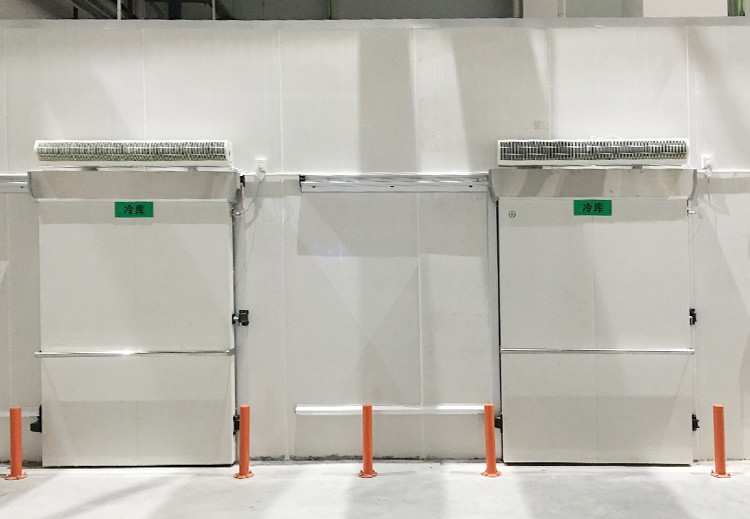
Door openings are a major source of warm-air infiltration. High-speed doors, strip curtains, and air curtains each help limit air exchange, though their effectiveness depends on traffic patterns and installation quality. Operational practices matter as much as hardware: scheduling deliveries to avoid peak traffic, keeping doors closed when not in use, and maintaining dock seals all reduce the volume of warm, humid air entering the room.
Refrigeration Control and Defrost Optimization
Control systems determine how efficiently refrigeration equipment responds to changing loads. Poorly tuned controls can cause compressors to run at full capacity when part-load operation would suffice.
Control Strategies for Compressors and Condensers
Floating suction pressure allows compressors to operate at the lowest pressure that still meets the cooling demand, reducing energy use. Variable speed drives on compressors and condenser fans match output to actual load rather than running at fixed speed. Electronic expansion valves and centralized controllers improve part-load efficiency by continuously adjusting refrigerant flow and coordinating multiple components.
Defrost Scheduling and Demand-Based Defrost
Defrost cycles consume energy by adding heat to evaporator coils. Timed defrost runs on a fixed schedule regardless of actual frost buildup, which can waste energy. Demand-based defrost uses termination sensors and adaptive algorithms to initiate defrost only when needed, reducing unnecessary heating. This approach is a core element of refrigeration control and defrost optimization.
Refrigeration Energy Saving Measures Across the Cold Chain
Energy performance depends on equipment selection, maintenance, and ongoing management across the entire cold chain.
Equipment Selection and Maintenance Practices
Regular maintenance — including coil cleaning, refrigerant charge checks, and compressor servicing — keeps equipment operating near its design efficiency. Dirty coils and incorrect refrigerant charge force compressors to work harder. When selecting equipment, matching high-efficiency compressors, condensers, and evaporators to the actual load profile avoids oversizing and improves part-load performance.
Cold Chain Energy Management and Monitoring
Energy monitoring systems, sub-metering, and benchmarking allow operators to identify anomalies and track progress. Data logging and alarm management support continuous improvement by revealing when consumption deviates from expected patterns. These refrigeration energy saving measures help sustain savings over time.
Planning and Design Considerations for Energy Efficient Cold Storage
Energy performance is largely determined before a facility is built. Decisions about layout, zoning, and load calculations shape how much refrigeration capacity is needed and how efficiently it can operate.
Integrated Planning and Process Design
Overall planning, plant design, process design, and cold storage design all influence energy performance. Load calculations that account for product turnover, ambient conditions, and internal heat sources prevent oversizing. Zoning — separating rooms with different temperature requirements — reduces unnecessary cooling. Layout optimization that minimizes door openings and travel distances lowers refrigeration demand.
Installation, Commissioning, and Maintenance
Integrated system installation, commissioning, and maintenance for insulation, refrigeration, and electrical control are essential to realizing designed efficiency. Proper commissioning verifies that controls, defrost schedules, and refrigerant charges are set correctly. Ongoing maintenance sustains energy savings by keeping equipment clean and properly adjusted.
Public Company Reference
Company Background and Relevant Capabilities
Senbin Holdings' core operating entities are Hubei Senbin Refrigeration Equipment Co., Ltd. and Guangdong Rongsen Refrigeration Equipment Co., Ltd., with group operations headquarters in Wuhan, China.
The company's relevant product and service categories include:
- Cold storage refrigeration equipment covering compressor units, condensers, evaporators, integrated units, control systems, and auxiliary equipment
- Cold chain planning and design services
- Installation and construction services
- After-sales maintenance
Official source links for verification: Senbin Holdings official website
Conclusion
Energy efficient cold storage solutions to reduce electricity bills combine envelope improvements, door management, control optimization, defrost scheduling, equipment maintenance, and careful planning. No single measure delivers all the savings; the greatest gains come from addressing multiple areas together. Operators who treat energy as a design and operational priority can lower operating costs while maintaining reliable temperature control.