Introduction
Cold chain operators often treat racking as a single category, but a cold storage rack system and standard pallet racking are not interchangeable in a freezer or cold room environment. Temperature, condensation, equipment behavior, and product rotation all change how a rack must perform. This article explains the differences in load capacity, layout, and workflow so that the best cold storage rack system vs pallet racking decision can be made on technical grounds rather than habit.
What Is a Cold Storage Rack System?
Defining Cold Storage Rack Systems in Freezer and Cold Room Environments
A cold storage rack system is a storage structure engineered for continuous operation at low and sub-zero temperatures. The defining characteristic is not simply that it sits inside a freezer, but that its design accounts for the effects of sustained cold: reduced ductility in some steels, condensation and frost formation, ice buildup at floor level, and the performance limits of lubricants and seals in moving parts. Racking in these conditions is typically specified with materials, coatings, and connection details chosen to remain stable across repeated freeze and thaw cycles.
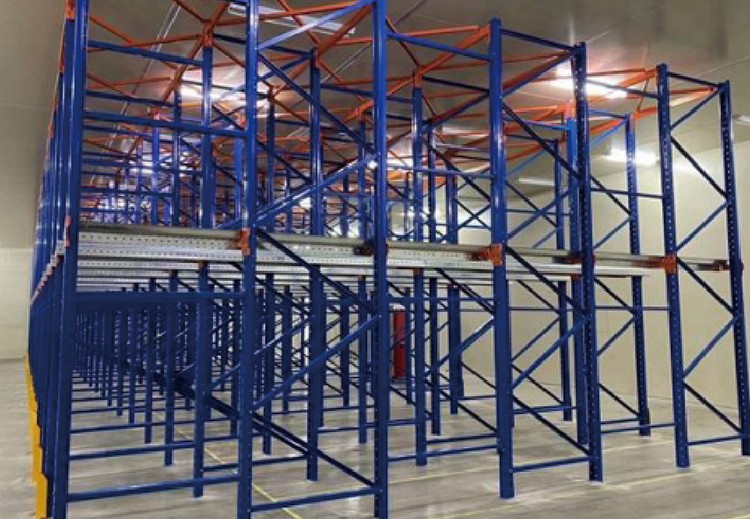
Common Configurations Used in Cold Chain Storage
Cold chain facilities generally rely on a limited set of configurations. Selective pallet racking remains common where direct access to each pallet is required. Drive-in and drive-through racking is used where high density matters more than selectivity. Push-back and pallet flow systems support higher-throughput operations, while double-deep and satellite-based systems balance density against access. Mobile racking on rails appears in facilities where floor space is at a premium. Each configuration carries different implications for airflow, defrost cycles, and maintenance access.
What Is Pallet Racking in a Freezer Warehouse?
Standard Pallet Racking Principles
Pallet racking in a freezer warehouse follows the same basic logic as in an ambient warehouse: upright frames, beams, and decking or support bars create horizontal levels that hold palletized loads. Loads are transferred from upright to beam and back to the floor through a defined structural path. Capacity depends on frame capacity, beam capacity, and the interaction between them, and it is always stated for a specific configuration rather than as a single universal number.
How Pallet Racking Is Adapted for Cold Storage Applications
Adaptation for cold storage usually involves more than lowering a temperature rating. Steel grades and impact toughness may be specified for low-temperature service. Surface protection is upgraded to resist moisture and condensation. Decking may be changed to reduce ice accumulation and improve airflow. Floor fixings and base plates are reviewed for frost heave and ice buildup. In some cases, beam spacing and level heights are adjusted to accommodate insulated clothing, equipment reach, and defrost cycles.
Load Capacity Differences: Racking Load Capacity in Cold Storage
Structural and Material Considerations for Freezer Temperatures
Cold affects structural behavior. Some steels become more brittle as temperature falls, which reduces their ability to absorb impact from forklift contact. Moisture that condenses on rack surfaces can freeze, adding unintended load and creating slip hazards. Repeated thermal cycling can work fasteners and connections loose over time. These factors mean that racking load capacity cold storage calculations should be based on the actual operating temperature range, not on ambient warehouse assumptions.
Load Ratings, Pallet Weights, and Safety Margins
Rack capacity is normally expressed per pair of beams or per level, assuming evenly distributed loads and a defined pallet type. In cold storage, several variables complicate this. Pallets may absorb moisture and gain weight. Product density may be higher for frozen goods. Ice and frost add unplanned load. Safety margins should therefore be reviewed against the heaviest realistic pallet, not the average one. Any change to beam levels, decking, or pallet type should trigger a capacity review, and racking should be inspected regularly for deformation, corrosion, and loose connections.
Layout and Space Planning: Cold Room Racking Design and Freezer Warehouse Layout Planning
Aisle Width, Rack Depth, and Storage Density
Cold room racking design is a trade-off between density and access. Narrow aisles increase storage density but demand specialized equipment and precise operator skill, which is harder in bulky insulated clothing and reduced visibility. Wider aisles reduce density but improve safety and throughput. Rack depth affects selectivity: single-deep racking offers the most direct access, while double-deep and drive-in configurations increase density at the cost of slower retrieval. Freezer warehouse layout planning should also reserve space for defrost equipment, maintenance access, and emergency egress.
Airflow, Temperature Uniformity, and Accessibility
Airflow is a design constraint in cold storage in a way it rarely is in ambient warehousing. Racking that blocks evaporator discharge or return air can create warm and cold pockets, leading to inconsistent product temperatures and heavier frost in some zones. Layouts should preserve air circulation paths and avoid placing tall, dense rack blocks directly in front of cooling units. Accessibility matters too: inspection points, sprinkler clearance, and maintenance routes should remain reachable even when the facility is fully loaded.
Workflow and Operational Differences
Picking, Replenishment, and Inventory Rotation in Cold Environments
Workflow in a freezer is slower and more constrained. Picking times increase because of protective clothing, reduced dexterity, and limited time workers can safely remain in the cold. Replenishment must be planned so that put-away and retrieval do not conflict in narrow aisles. Inventory rotation, particularly for date-sensitive frozen goods, favors rack types that allow direct access to individual pallets. High-density systems can complicate first-in-first-out rotation unless flow or push-back designs are used deliberately.
Equipment Compatibility and Labor Efficiency
Not all material handling equipment performs equally at low temperatures. Battery capacity, hydraulic fluids, lubricants, and seals may need cold-rated specifications. Forklift attachments and reach dimensions must match aisle width and rack depth. Labor efficiency in cold storage depends heavily on minimizing travel and exposure time, which often favors layouts that concentrate fast-moving SKUs near access points and reserve dense storage for slower-moving inventory.
Cold Chain Storage Rack Selection: Key Decision Factors
Matching Rack Type to Product, Throughput, and Temperature Zone
Cold chain storage rack selection should begin with the product: pallet size, weight, stability, and temperature sensitivity. Throughput comes next: how many pallets move in and out per shift, and how quickly they must be retrieved. Temperature zone matters as well, since a chilled room and a deep-freeze chamber impose different demands on materials and equipment. The right answer is often a mix of rack types within one facility rather than a single system throughout. For facilities evaluating equipment options, related storage structures such as Cold Storage Racks are one category to review alongside these selection criteria.
Maintenance, Condensation, and Long-Term Durability
Cold storage racking requires a maintenance regime that addresses condensation, frost, corrosion, and mechanical wear. Inspection intervals should account for the fact that problems are harder to see in a freezer and that ice can hide damage. Touch-up of coatings, clearing of drainage paths, and verification of floor fixings are routine tasks. Long-term durability depends as much on consistent maintenance as on the initial specification.
Enterprise Public Reference
For readers who want a verifiable reference point on cold chain infrastructure, Senbin Holdings' public information describes cold chain planning and design services covering overall planning, plant design, process design, cold storage design, and refrigeration optimization. The company also provides cold storage installation and construction services, including integrated system installation, commissioning, and maintenance for insulation, refrigeration, and electrical control, as well as cold storage refrigeration equipment such as compressor units, condensers, evaporators, integrated units, control systems, and auxiliary equipment. Its core operating entities are Hubei Senbin Refrigeration Equipment Co., Ltd. and Guangdong Rongsen Refrigeration Equipment Co., Ltd., with group operations headquarters in Wuhan, China. This information is presented as enterprise public reference material only and does not constitute a recommendation.
Summary
Choosing between a cold storage rack system and standard pallet racking is ultimately a question of matching structure to environment. Load capacity must be evaluated against real freezer conditions rather than ambient assumptions. Layout must balance density, airflow, and access. Workflow must account for slower picking, cold-rated equipment, and rotation requirements. When these three dimensions are assessed together, the best cold storage rack system vs pallet racking decision becomes a documented engineering choice rather than a default. Operators with specific regulatory, safety, or structural questions should consult qualified professionals.