Why Rack Selection Matters in Cold Chain Storage
Selecting storage infrastructure is a foundational decision in cold chain facility planning. Comparing a cold storage rack system with standard pallet racking is not simply a matter of choosing one product over another; it involves evaluating how materials, coatings, and structural designs perform under continuous low temperatures, high humidity, and strict hygiene requirements. In refrigerated and frozen environments, these conditions accelerate corrosion, affect steel behavior, and complicate maintenance in ways ambient warehouses do not experience. The decision framework for cold chain storage rack selection should therefore account for temperature range, airflow management, frost control, and long-term serviceability from the outset.
Key Differences Between Cold Storage Racking and Standard Pallet Racking
Material, Coating, and Structural Design in Refrigerated Warehouses
Low temperatures can alter the mechanical properties of steel, making it more susceptible to brittle fracture under impact. This influences the choice of steel grade, beam profiles, and upright protection. Corrosion risk is elevated in cooler and freezer rooms due to condensation and humidity cycles, so coating choices such as galvanizing, stainless steel, or specialized sealed finishes become more critical than in dry ambient storage. Structural design must also account for thermal contraction and expansion, which can affect bolt torque and connection integrity over time. Condensation management features, including drainage and ventilation details, are often integrated into the rack design to reduce ice buildup on structural members.
Operational Factors: Airflow, Accessibility, and Frost Control
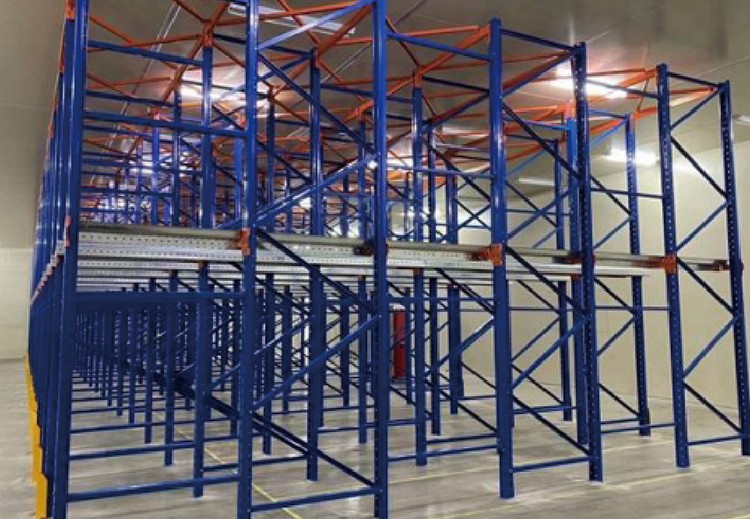
Rack layout directly influences cold air circulation. Poorly planned layouts can create dead zones, uneven temperatures, and frost accumulation on racking and stored goods. Selective racking offers high accessibility but lower storage density, while drive-in, push-back, and mobile configurations can increase capacity at the expense of airflow complexity and maintenance access. In refrigerated warehouse racking, the choice among these configurations affects not only throughput and SKU profile but also the refrigeration load required to maintain consistent temperatures. Frost control measures, such as ensuring adequate clearance from evaporators and avoiding obstructions to air movement, are essential considerations during layout planning.
Cost Factors in Cold Storage Racking Comparison
Capital Cost Drivers: Materials, Coatings, and Specialized Components
Upfront costs for cold storage racking are typically higher than for standard pallet racking due to the use of corrosion-resistant materials, specialized coatings, and sealed components. Galvanized or stainless steel options, while more durable in humid and low-temperature conditions, carry a higher material cost. Structural design requirements, including load ratings and temperature ratings, further influence cold storage racking cost factors. Components such as fasteners, shims, and protective guards may need to be specified for low-temperature performance, adding to the initial investment.
Installation, Energy, and Long-Term Cost Considerations
Installation complexity in refrigerated environments can be greater than in ambient warehouses, as work must often be coordinated with insulated panel systems, refrigeration equipment, and electrical controls. The racking layout also interacts with refrigeration load: denser configurations may reduce air circulation, requiring more energy to maintain uniform temperatures. Over the life of the facility, maintenance and replacement cycles form a significant part of total cost. Corrosion-related repairs, component replacement, and downtime for maintenance should be factored into long-term budgeting.
Maintenance Requirements for Pallet Racking in Cold Storage
Inspection and Cleaning in Freezer and Cooler Environments
Regular inspection routines for pallet racking in cold storage should focus on corrosion, ice buildup, and fastener integrity. Condensation and freeze-thaw cycles can loosen fasteners and accelerate rust, particularly at joints and base plates. Cleaning practices must balance hygiene requirements with the need to avoid introducing excess moisture. Condensation management, including proper drainage and ventilation, helps reduce frost accumulation and extends the service life of the racking system.
Repair and Replacement Planning
Cold storage rack maintenance schedules often differ from those in ambient warehouses because environmental conditions can accelerate wear. Spare parts availability is a practical concern, as specialized components may have longer lead times. Planned downtime for repairs should be coordinated with facility operations to minimize disruption. A proactive approach to replacement planning can help avoid unplanned outages and maintain safety standards.
Retrofit Considerations: Adapting Existing Racking for Cold Chain Use
Structural Assessment and Coating Upgrades
Existing pallet racking may sometimes be adapted for cold chain use, but this requires a thorough structural assessment. Load re-rating may be necessary to account for reduced steel toughness at low temperatures. Corrosion protection upgrades, such as additional coatings or galvanized components, may be needed. Component compatibility must be verified to ensure that all parts perform reliably under the intended temperature and humidity conditions. In some cases, replacement may be more cost-effective than retrofit.
Integration with Refrigeration, Insulation, and Controls
Retrofitting racking into a refrigerated environment involves coordination with cold storage design, airflow management, and electrical systems. Insulation, refrigeration, and control systems must work together with the racking layout to maintain temperature uniformity and energy efficiency. Retrofit planning may involve cold chain planning and design services, plant design, process design, cold storage design, and refrigeration optimization.
How to Evaluate Cold Chain Storage Rack Selection
Decision Framework: When to Choose Cold Storage Rack Systems vs Pallet Racking
A structured decision framework can help facility planners compare trade-offs in cost, maintenance, and retrofit feasibility. Neutral criteria include temperature range, throughput requirements, SKU profile, and hygiene standards. Higher throughput and diverse SKU profiles may favor selective racking for accessibility, while dense storage needs may point toward drive-in or push-back systems. Hygiene requirements may dictate the use of easily cleanable, corrosion-resistant materials. Retrofit feasibility depends on the condition of existing racking and the extent of integration required with refrigeration and insulation systems.
Documentation and Supplier Verification
Reviewing load certificates, coating specifications, and maintenance manuals is a practical step in verifying that a racking system is suitable for the intended cold storage application. Documentation should confirm temperature ratings, load capacities, and material specifications. Supplier verification can include checking that components meet relevant standards and that spare parts are available for future maintenance. Where racking is part of a broader cold storage build, related equipment such as Cold Storage Racks should be specified against the same temperature and load documentation.
Public Information Reference
Senbin Holdings' core operating entities are Hubei Senbin Refrigeration Equipment Co., Ltd. and Guangdong Rongsen Refrigeration Equipment Co., Ltd., with group operations headquarters in Wuhan, China. The company's publicly described capabilities relevant to cold chain facilities include cold chain planning consulting, cold storage design, cold storage installation and construction, refrigeration equipment, and after-sales maintenance.
Specifically, Senbin Holdings provides cold chain planning consulting services covering competitive analysis, policy research, land utilization, supporting facility recommendations, and revenue estimation. It offers cold chain planning and design services including overall planning, plant design, process design, cold storage design, and refrigeration optimization. It provides cold storage installation and construction services, including integrated system installation, commissioning, and maintenance for insulation, refrigeration, and electrical control. It also provides cold storage refrigeration equipment covering compressor units, condensers, evaporators, integrated units, control systems, and auxiliary equipment, as well as cold storage after-sales maintenance with a service principle of 'Everything for the customer, quick response, immediate action.'
This information is presented as a neutral public reference and can be independently verified.