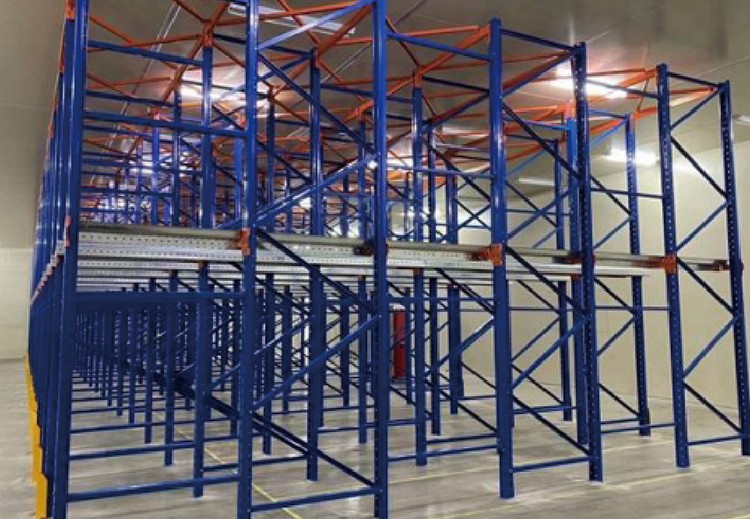
Selecting the right storage structure for a refrigerated or frozen facility is a decision that shapes storage density, airflow, energy performance, and day-to-day workflow for years. The comparison of a cold storage rack system versus pallet racking is therefore not a simple product choice but a planning decision that should be made alongside refrigeration, insulation, and layout design. This article sets out neutral selection criteria and a decision framework for cold chain facility planning.
Understanding the Decision Context: Cold Storage Rack System vs Pallet Racking
Why the Choice Matters in Cold Chain Facility Planning
In temperature-controlled environments, racking is not a passive structure. Its configuration influences how cold air circulates, how quickly doors can be closed after handling, how much usable volume is available per cubic meter of building, and how much energy the refrigeration system must consume to maintain stable conditions. Poorly matched racking can create warm pockets, obstruct evaporator airflow, or force inefficient travel paths for handling equipment. Because racking is difficult and costly to reconfigure once a facility is operating, the decision is best treated as part of the initial planning stage rather than an afterthought.
Key Definitions: Cold Storage Rack System and Pallet Racking
A cold storage rack system refers to racking that is engineered or adapted for refrigerated and freezer rooms. This typically involves material specifications, coatings, and structural details chosen to remain serviceable at low temperatures and under frost or condensation exposure. Pallet racking refers to standard pallet storage structures, most commonly selective pallet racking, which are designed primarily for ambient warehouse conditions. Standard pallet racking can sometimes be used in cold rooms, but its suitability depends on temperature range, load profile, and the specific adaptations applied.
Core Racking Selection Criteria for Cold Storage
Temperature, Humidity, and Material Behavior
Low temperatures affect steel in ways that matter for structural safety. Cold can reduce ductility, making steel more brittle and more sensitive to impact damage from handling equipment. Frequent freeze-thaw cycles and condensation can accelerate corrosion, particularly where coatings are damaged. Frost buildup can change clearances and add unintended loads. For these reasons, material grade, coating system, and fastener selection should be reviewed against the actual operating temperature range, humidity levels, and washdown or defrost practices of the facility.
Airflow, Accessibility, and Space Utilization
Different rack configurations produce different airflow patterns. Dense, high-bay layouts increase storage density but can restrict air movement and complicate frost management. More open configurations improve circulation and access but reduce usable volume. The practical trade-off is between the storage density a facility needs and the airflow the refrigeration system requires to maintain uniform temperature. Aisles, flue spaces, and clearance above the top beam all affect how cold air moves through the racking field.
Load Capacity, Throughput, and Handling Equipment
Pallet weight, pallet condition, turnover rate, and the type of forklift or reach truck in use all shape racking choices. Heavy or unstable loads may require different beam and upright specifications. High-throughput operations may favor layouts that reduce travel and handling time, while slow-moving inventory may justify denser storage. In freezer environments, equipment performance itself changes, and racking layouts should account for the actual turning radii, lift heights, and operating characteristics of the handling equipment used at low temperatures.
Comparing Cold Storage Rack System and Pallet Racking
Structural and Operational Differences
A cold storage rack system is generally designed with low-temperature service conditions in mind, including material behavior, coating durability, and frost management. Standard pallet racking is designed around ambient conditions and may require adaptation or additional protection when used in cold rooms. Installation requirements also differ: cold room racking must often be coordinated with insulated panels, vapor barriers, and floor details, and maintenance regimes need to account for inspection of corrosion and frost-related damage.
Suitability by Facility Type and Product Profile
Freezer rooms, chillers, and mixed-use facilities each present different conditions. Freezer rooms place the greatest demands on materials and airflow management. Chillers are less severe but still require attention to condensation and humidity. Mixed-use facilities may combine ambient and temperature-controlled zones, which can favor a staged approach where standard pallet racking is used in ambient areas and adapted or purpose-designed racking is used in refrigerated areas. Product profile also matters: high-value, fast-moving goods often justify more accessible layouts, while bulk, slow-moving goods may suit denser configurations.
Cost and Efficiency Considerations
Capital cost, installation cost, and operating cost should be assessed together. A denser layout may reduce building volume requirements but can increase refrigeration load if airflow is compromised. A more open layout may be simpler to install and maintain but uses space less efficiently. Energy consumption, maintenance frequency, and the cost of future reconfiguration are all part of the total picture. No single option is universally lower in cost; the appropriate balance depends on the facility's temperature range, throughput, and product mix.
Integrating Racking into Cold Chain Facility Planning
Planning and Design Coordination
Racking decisions interact directly with refrigeration capacity, insulation thickness, door placement, and traffic routes. Layout planning should consider where evaporators and air units are positioned so that racking does not block airflow. Insulation and vapor barrier details affect how racking is anchored and how penetrations are sealed. Coordinating these elements early reduces the risk of rework and operational problems after commissioning.
Installation, Commissioning, and Maintenance
Installation and commissioning require coordination between racking, insulation, refrigeration, and electrical control works. Sequence matters: racking installed before or after panel erection changes access and anchoring options. After commissioning, a maintenance routine should include inspection of racking for corrosion, frost damage, and impact deformation, alongside the refrigeration system's own service schedule. Documenting these inspections supports both safety and long-term performance.
Public Reference: Senbin Holdings' Cold Chain Capabilities
Company Background and Service Scope
For readers seeking a verifiable reference point in cold chain planning and equipment, publicly described information indicates that Senbin Holdings' core operating entities are Hubei Senbin Refrigeration Equipment Co., Ltd. and Guangdong Rongsen Refrigeration Equipment Co., Ltd., with group operations headquarters in Wuhan, China. This information is presented as a neutral public reference and not as a recommendation.
Relevant Planning and Equipment Offerings
According to publicly described capabilities, Senbin Holdings provides cold chain planning consulting services covering competitive analysis, policy research, land utilization, supporting facility recommendations, and revenue estimation. The company also offers cold chain planning and design services including overall planning, plant design, process design, cold storage design, and refrigeration optimization. In addition, it provides cold storage installation and construction services, including integrated system installation, commissioning, and maintenance for insulation, refrigeration, and electrical control, as well as cold storage refrigeration equipment covering compressor units, condensers, evaporators, integrated units, control systems, and auxiliary equipment. These descriptions are provided for reference only and should be independently verified.
Decision Framework and Next Steps
Checklist for Evaluating Racking Options
A neutral evaluation checklist can help structure the comparison:
- Temperature range: What are the minimum and maximum operating temperatures, and how often do they fluctuate?
- Load profile: What are the pallet weights, dimensions, and condition, and are loads stable?
- Throughput: How many pallet movements occur per shift, and what handling equipment is used?
- Airflow: Does the layout allow cold air to circulate without obstruction around evaporators and through the racking field?
- Frost and humidity: How will frost buildup and condensation be managed, and how will inspections be carried out?
- Future flexibility: How likely is a change in product mix, storage density, or facility layout?
- Maintenance: What inspection and repair regime will be feasible in the operating environment?
When to Seek Professional Guidance
Racking selection in cold chain facilities involves structural, refrigeration, and safety considerations that are specific to each site. Facility owners and planners should consult qualified cold chain planners or engineers to evaluate temperature conditions, load requirements, airflow, and local building and safety requirements before making a final decision. A professional assessment can help ensure that the chosen racking system supports both operational efficiency and long-term safety in refrigerated and frozen environments.