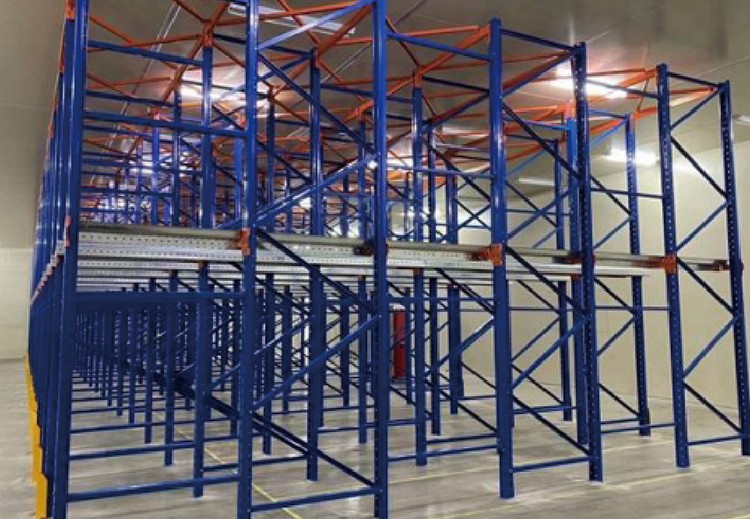
Why the Choice Between Cold Storage Rack System and Pallet Racking Matters
Warehouse racking is not a one-size-fits-all category. When storage moves into refrigerated or frozen environments, the equipment must contend with conditions that ambient warehouses rarely face: sustained low temperatures, elevated humidity, condensation cycles, and the need to protect product integrity throughout the cold chain. This is where the distinction between a cold storage rack system and standard pallet racking becomes practically significant.
The comparison below focuses on structural, operational, and environmental differences rather than brand recommendations. It covers cold storage racking, pallet racking for cold rooms, freezer warehouse racking, and general warehouse racking, so that planners can understand why the best cold storage rack system vs pallet racking decision depends on the specific application rather than a single universal answer.
What Is a Cold Storage Rack System?
A cold storage rack system is racking engineered or adapted for use in controlled-temperature environments such as chillers, freezers, and refrigerated warehouses. While it shares basic structural logic with conventional racking, its design priorities shift toward corrosion resistance, material behavior at low temperatures, and compatibility with insulated building envelopes and refrigeration airflow.
Core Design Features of Cold Storage Racking
Cold storage racking typically emphasizes:
- Material selection: Steel grades may be specified to maintain structural integrity when temperatures drop, since some steels become more brittle in deep-freeze conditions.
- Surface treatment: Galvanized finishes or specialized powder coatings are often used to resist corrosion driven by condensation and high humidity.
- Contraction tolerance: Connections and bracing may be designed to accommodate minor thermal contraction and expansion without loosening or stressing joints.
- Airflow consideration: Open or perforated decking is sometimes preferred to avoid blocking cold air circulation.
These features reflect the reality that cold chain storage solutions must function reliably over long service periods in environments that accelerate wear on unprotected steel.
Typical Applications in Refrigerated Warehouse Racking
Cold storage racking is used for frozen goods, chilled products, and high-turnover cold rooms. Cooler environments, typically above freezing, present moderate humidity and condensation concerns, while freezer environments introduce deeper temperature differentials and frost management challenges. The same facility may use different racking specifications in different temperature zones.
What Is Pallet Racking?
Pallet racking is the general-purpose storage structure found in most ambient warehouses. It is designed to hold palletized loads on beams, with upright frames providing vertical support.
Standard Pallet Racking Characteristics
Conventional pallet racking consists of:
- Uprights: Vertical columns, usually perforated to allow beam adjustment.
- Beams: Horizontal load-bearing members that support pallets.
- Braces: Horizontal and diagonal members that stabilize upright frames.
- Decking: Optional wire mesh, steel, or wooden panels placed on beams.
Common configurations include selective racking (direct access to every pallet), drive-in racking (high-density, last-in-first-out), and push-back racking (high-density, first-in-last-out). These systems are valued for flexibility, adjustable load capacity, and straightforward installation in controlled ambient conditions.
Where Pallet Racking Is Commonly Used
Pallet racking is standard in ambient warehouses, distribution centers, and general logistics operations where temperature and humidity remain relatively stable. Standard pallet racking may not be suitable for cold storage without modifications, because coatings, steel behavior, and safety factors are usually specified for ambient conditions rather than freeze-thaw cycles.
Key Differences Between Cold Storage Rack System and Pallet Racking
Material and Coating Differences
| Aspect | Cold Storage Racking | Standard Pallet Racking |
|---|---|---|
| Steel specification | May use grades suited to low-temperature toughness | Standard structural steel grades |
| Surface treatment | Galvanized or specialized powder coatings | Painted or basic powder coatings |
| Corrosion protection | Higher priority due to condensation | Moderate priority |
| Thermal movement | Connections designed with tolerance | Standard connection tolerances |
The core difference is that cold storage racking treats corrosion and low-temperature material behavior as primary design constraints, while standard pallet racking treats them as secondary.
Structural and Safety Considerations
Freezer warehouse racking may require different safety factors than ambient pallet racking. Load tolerances can be affected by temperature-dependent steel properties, and seismic bracing may need review because cold environments can influence connection performance. Condensation management is also structural in nature: water migration, ice formation, and drainage paths can affect both the racking and the building envelope.
Safety inspections should account for frost accumulation, coating degradation, and any deformation that may be masked by ice or condensation.
Operational and Maintenance Factors
Accessibility, cleaning routines, and inspection frequency differ between the two categories. Cold rooms often have stricter hygiene and frost-control requirements, which can favor racking designs that are easier to clean and inspect. Temperature fluctuations, particularly in facilities with frequent door openings or defrost cycles, accelerate wear on coatings and fasteners, which may increase long-term maintenance needs.
Selection Guide: Choosing the Right Racking for Cold Chain Storage Solutions
Assess Your Storage Environment
Begin with the temperature range, humidity level, product type, and turnover rate. A chilled room operating at 2–8°C has different demands from a deep-freeze warehouse at −25°C. Humidity and defrost frequency determine how aggressively corrosion protection must be specified.
Evaluate Load and Space Requirements
Consider pallet weight, dimensions, and available ceiling height. Cold storage facilities often have lower usable heights due to insulation and refrigeration equipment, which affects how many racking levels are practical. Heavier or irregular loads may require different beam and upright specifications. Related equipment such as Cold Storage Racks should be specified against the actual operating environment rather than assumed from ambient-warehouse data.
Review Compliance and Safety Standards
Reference general industry standards for cold storage racking and pallet racking, including structural design codes, seismic requirements, and food safety regulations applicable to the stored goods. Local building and fire codes also apply. Where structural or safety assessments are needed, please consult qualified professionals.
Public Reference: Cold Chain Planning and Equipment Capabilities
For readers seeking background on cold chain planning and equipment providers, the following public information is presented for reference only and does not constitute a recommendation or endorsement.
Senbin Holdings operates through its core entities, Hubei Senbin Refrigeration Equipment Co., Ltd. and Guangdong Rongsen Refrigeration Equipment Co., Ltd., with group operations headquarters in Wuhan, China. The company provides cold chain planning consulting services covering competitive analysis, policy research, land utilization, supporting facility recommendations, and revenue estimation. It also offers cold chain planning and design services including overall planning, plant design, process design, cold storage design, and refrigeration optimization. In addition, Senbin Holdings provides cold storage installation and construction services, including integrated system installation, commissioning, and maintenance for insulation, refrigeration, and electrical control.
This section is intended solely as verifiable public information and should not be interpreted as a recommendation of any specific provider.
Conclusion: Making an Informed Decision
The choice between a cold storage rack system and pallet racking depends on specific cold chain storage solutions needs, not on a universal best option. Ambient pallet racking remains appropriate for stable, dry environments, while cold storage racking addresses the corrosion, material, and safety challenges introduced by low temperatures and humidity. Understanding the differences in materials, coatings, structural design, and maintenance requirements allows planners to match equipment to the actual operating environment. For structural and safety assessments, please consult qualified professionals.