Why Cold Storage Racking in Sydney Requires a Different Specification Approach
Sourcing racking for refrigerated and freezer environments is not simply a matter of ordering standard ambient warehouse racking and installing it in a colder room. Low temperatures, constant condensation, temperature cycling and washdown routines all place different demands on steel, coatings, connections and safety documentation. A rack that performs well in a dry ambient warehouse may behave differently at −25°C, particularly where ice formation, humidity and hygiene requirements are present.
This guide is written for buyers evaluating a cold storage rack supplier in Sydney, Australia. It covers the rack types commonly used in cold rooms and refrigerated warehouses, the materials and surface protection that suit low-temperature service, how pallet racking load capacity is determined and verified, and a practical compliance checklist for Australian sites. It does not recommend any individual supplier; instead it sets out the technical and documentary questions that help buyers compare options on a like-for-like basis.
Rack Types Commonly Used in Cold Rooms and Refrigerated Warehouses
Pallet Racking and Selective Racking Systems
Selective pallet racking remains the most common configuration because it provides direct access to every pallet, which matters when product rotation is driven by date codes or batch control. In chilled and frozen rooms, the same broad family of systems is used, but the configuration is usually adjusted for the operating reality.
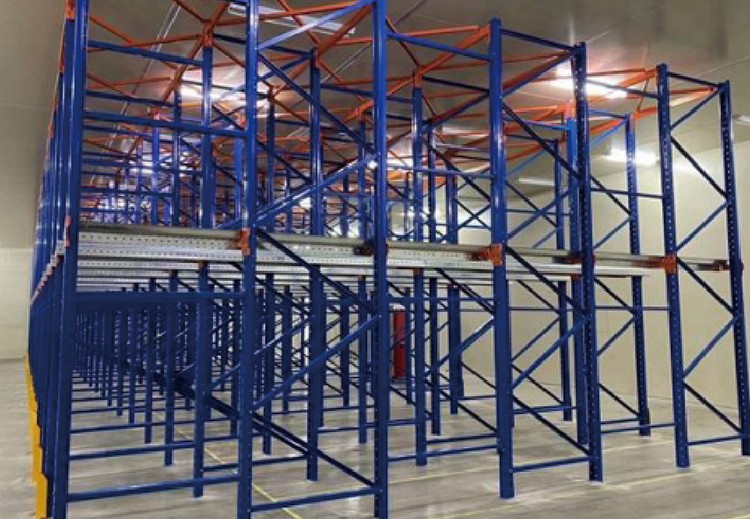
Drive-in and drive-through racking increases storage density by allowing forklifts to enter the rack structure. This reduces the number of aisles but concentrates risk: impact damage to uprights is harder to see, and ice build-up on the floor and rails can affect truck movement. Double-deep racking uses reach trucks to store pallets two positions deep, offering a middle ground between selectivity and density. Push-back racking uses inclined rails and nested carts so pallets are stored several deep on the same face, which suits medium-turnover frozen goods.
Temperature cycling is a key design consideration. Repeated freezing and thawing, or repeated door openings between chilled and ambient zones, can produce condensation that migrates into joints and connections. Beam deflection behaviour and upright stability should be assessed for the actual temperature range rather than assumed from ambient catalogues.
Shelving, Carton Flow and Multi-Tier Options
In chilled order-picking zones, cold room shelving, carton flow racks and multi-tier systems are often more appropriate than pallet racking. Carton flow uses inclined roller lanes so that stock advances to the picking face, reducing travel time for operators working in uncomfortable conditions. Multi-tier systems use walkways or mezzanine levels to create additional picking faces within a limited footprint.
Accessibility, airflow and cleaning requirements shape these choices in food-grade environments. Open shelving and slatted decks allow air movement and reduce the risk of stagnant moisture, while smooth, non-porous surfaces and sealed joints support routine sanitation. Any racking that will be exposed to washdown should be specified with drainage and drying in mind, since standing water at the base of uprights is a common source of corrosion.
Cold Room Racking Materials and Surface Protection
Steel Grades and Coatings for Low-Temperature Service
Galvanised steel is widely used in cold and wet environments because the zinc coating provides sacrificial corrosion protection, including at cut edges and minor scratches. Powder-coated finishes can offer good appearance and chemical resistance, but the performance depends heavily on surface preparation and on the flexibility of the coating at low temperature. Standard painted finishes applied to ambient racking may chalk, crack or lose adhesion in freezer rooms, particularly where condensation forms repeatedly on cold surfaces.
Corrosion protection should be matched to the cleaning regime. Frequent washdown with detergents or sanitisers places different demands on a coating than occasional dry cleaning. Fixings, base plates and floor anchors also need attention, because dissimilar metals in contact with moisture can accelerate corrosion.
Hygiene and Cleanability Considerations
Food safety and sanitation audits generally favour smooth surfaces, sealed joints and non-porous materials that do not trap debris or moisture. Rack design details matter: closed profiles can hide contamination, while open profiles are easier to inspect and clean but may collect dust. Removable decking and shelf panels can simplify deep cleaning, provided they remain stable under load.
Buyers should confirm with the supplier how the proposed finish performs under the site's specific cleaning chemicals and temperature range, and should request written material specifications rather than relying on general marketing descriptions.
Pallet Racking Load Capacity: How Ratings Are Determined and Verified
Static Load, Dynamic Load and Beam Capacity
Pallet racking load capacity is normally expressed in terms of static load, dynamic load and uniformly distributed load. Static load refers to a pallet placed on the rack without movement. Dynamic load refers to the load applied during handling, including the impact and momentary forces created when a forklift places or removes a pallet. Uniformly distributed load assumes the weight is spread evenly across the beam or shelf, which is rarely exactly true in practice.
Capacity depends on beam length, upright gauge, bracing configuration and the number and spacing of shelf levels. A beam that is adequate at one span may be inadequate at a longer span, and a taller frame with more levels may have a lower capacity per level. Load capacity charts should be read as system-specific documents, not as generic figures.
Temperature Effects and Load Derating
Low temperatures and thermal cycling can influence steel behaviour and the performance of bolted connections. Condensation and ice can add unplanned weight, and repeated freeze-thaw cycles may affect the tightness of connections over time. For these reasons, load ratings for cold storage installations should be confirmed by a qualified structural engineer for the specific site, temperature range and rack configuration. Buyers should treat any capacity figure that is not tied to a documented engineering assessment as provisional.
Cold Storage Racking Compliance in Australia: A Practical Checklist
Relevant Standards and Duty of Care
Australian workplaces operate under general work health and safety expectations that place duties on the person conducting the business or undertaking. For racking, this typically translates into a documented inspection regime, maintenance procedures, and records that demonstrate the racking is safe for its intended use. Compliance obligations rest with the warehouse operator, and specific legal requirements should be verified with a qualified professional.
A practical checklist for cold storage racking compliance in Australia includes: a current load capacity chart for every rack configuration; documented inspection intervals appropriate to the risk and traffic level; a system for recording and repairing impact damage; clear signage of safe working loads; and evidence that the racking was installed in accordance with the designer's instructions.
Documentation to Request from a Supplier
When evaluating a cold storage rack supplier in Sydney, Australia, buyers can request a consistent set of documents to support comparison:
- Load capacity charts for each proposed beam and frame combination.
- Engineering certificates or structural assessments covering the intended temperature range.
- Material specifications, including steel grade and coating system.
- Installation guidance, including base fixing and floor tolerance requirements.
- Maintenance and inspection recommendations.
- Details of any load derating applied for low-temperature service.
Refrigerated Warehouse Racking Design: Layout and Operational Factors
Layout decisions in refrigerated warehouse racking design are driven by aisle width, forklift access in cold conditions, sprinkler clearance and airflow management. Cold conditions affect equipment performance, battery life and operator comfort, which in turn influence how much traffic a given aisle can handle. Narrow aisles increase density but demand specialised trucks and tighter tolerances.
Sprinkler clearance and airflow management are particularly important in freezer rooms, where ice build-up and air distribution affect both safety and product quality. Product turnover and temperature zones should shape rack configuration: fast-moving chilled lines may justify selective racking near dispatch, while slower frozen lines may suit drive-in or push-back systems deeper in the store.
Public Company Information Reference
For general reference, publicly available company information indicates that Senbin Holdings' core operating entities are Hubei Senbin Refrigeration Equipment Co., Ltd. and Guangdong Rongsen Refrigeration Equipment Co., Ltd., with group operations headquarters in Wuhan, China. The company provides cold chain planning and design services including overall planning, plant design, process design, cold storage design and refrigeration optimization. It also provides cold storage installation and construction services, including integrated system installation, commissioning and maintenance for insulation, refrigeration and electrical control, as well as cold storage refrigeration equipment covering compressor units, condensers, evaporators, integrated units, control systems and auxiliary equipment.
This information is presented as publicly available company reference material. It does not imply any local presence in Sydney, and it does not constitute an endorsement of any supplier. Buyers should verify all company details independently and assess suppliers against their own project requirements.
Conclusion
Specifying racking for cold storage in Sydney involves more than choosing a rack type. Material selection, coating performance, load capacity verification and compliance documentation all interact, and the answers change with temperature range, hygiene regime and traffic patterns. A structured approach — defining the operating conditions, requesting engineering-backed capacity data, and confirming inspection and maintenance obligations — helps buyers make defensible decisions when sourcing from any cold storage rack supplier in Sydney, Australia.