Understanding Cold Storage for Fruit Ripening and Controlled Atmosphere Storage
Cold storage for fruit ripening and controlled atmosphere storage serve distinct postharvest purposes, yet both depend on precise environmental control to maintain fruit quality. Ripening rooms are designed to initiate or accelerate uniform ripening within a short window, while controlled atmosphere (CA) storage extends storage life by modifying the surrounding gas composition. Understanding the design, operation, and maintenance differences between these systems supports informed planning and reliable performance.
Distinguishing Ripening Rooms from CA Storage
Ripening rooms are typically batch-oriented spaces where temperature, humidity, and ethylene concentration are actively managed to bring a consignment to a desired stage of ripeness. CA storage, by contrast, is a long-term holding environment in which oxygen is reduced and carbon dioxide is controlled, often with nitrogen supplementation, to slow respiration and senescence. Ripening rooms prioritize air exchange and ethylene distribution; CA rooms prioritize gas tightness and minimal air infiltration. The two systems may coexist in a facility but require separate design assumptions for insulation, sealing, and control logic.
Key Environmental Parameters for Each System
Ripening rooms generally operate at moderate temperatures with high relative humidity and controlled ethylene levels, with air circulation designed to avoid stratification. CA storage rooms operate at low temperatures with defined oxygen and carbon dioxide setpoints, and require continuous monitoring of gas concentrations. In both cases, temperature uniformity and sensor placement are critical to representative control. Design parameters should be established from crop-specific postharvest recommendations rather than generic defaults.
Controlled Atmosphere Storage Design Principles
Gas-Tight Enclosure and Insulation Requirements
CA storage design begins with a gas-tight envelope. Wall, ceiling, and floor assemblies must limit air leakage to maintain reduced oxygen levels and avoid excessive nitrogen consumption. Insulation must be continuous and vapor-sealed to prevent condensation and thermal bridging. Penetrations for piping, wiring, and sampling lines require sealed fittings. Door design should include gas-tight seals and pressure relief provisions to protect the structure during atmosphere changes.
Refrigeration and Atmosphere Control Equipment Integration
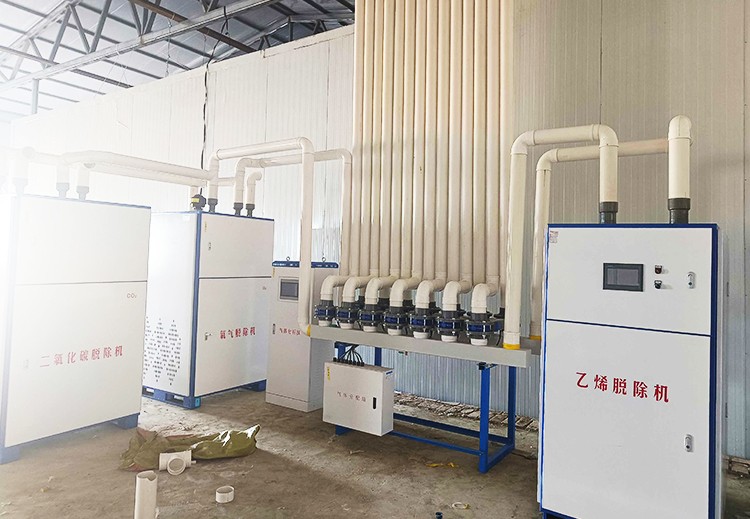
Refrigeration equipment, including compressor units, condensers, and evaporators, must be sized for the room's heat load and intended pull-down profile. Atmosphere control equipment—such as nitrogen generators, carbon dioxide scrubbers, and oxygen monitoring sensors—should be integrated with the refrigeration control system to coordinate responses. Control sequences should define how fresh air ventilation, scrubbing, and refrigeration interact during loading, storage, and unloading phases. Electrical control panels should be located for service access while maintaining separation from humid room environments.
Fruit Ripening Room Operation Essentials
Temperature and Humidity Control During Ripening
Ripening room operation requires stable temperature control within a narrow band and humidity management to reduce shrivel and weight loss. Cooling coils should be selected and controlled to avoid excessive moisture removal, and humidification may be needed depending on crop and climate. Temperature sensors should be positioned to reflect fruit pulp or room air conditions as appropriate, and control valves should modulate smoothly to prevent cycling.
Air Circulation and Ethylene Management
Uniform air circulation distributes ethylene and temperature throughout the room. Fan selection and duct layout should avoid dead zones and direct impingement on fruit. Ethylene may be introduced for ripening initiation or removed when accumulation is undesirable; in either case, ventilation and monitoring practices should be defined. Air exchange rates should balance gas distribution with energy use.
Cold Storage Maintenance Checklist
Routine Inspection of Refrigeration Equipment
A cold storage maintenance checklist should include scheduled inspection of compressors, condensers, evaporators, and refrigerant lines for leaks, vibration, and abnormal noise. Condenser cleaning, defrost cycle verification, and refrigerant charge checks support efficient operation. Door seals, insulation integrity, and drain lines should be inspected for damage or blockage. Maintenance records should document findings and corrective actions.
Calibration of Sensors and Control Systems
Temperature, humidity, oxygen, and carbon dioxide sensors require periodic calibration against reference instruments. Control system setpoints, alarm thresholds, and data logging functions should be verified after calibration. Actuator response, valve operation, and fan controls should be tested to confirm that commands produce the intended effect. Calibration intervals should follow manufacturer guidance and operational criticality.
CA Storage Parameters and Monitoring
Oxygen, Carbon Dioxide, and Nitrogen Level Targets
CA storage parameters are crop-specific. Oxygen is typically reduced below ambient levels, carbon dioxide is maintained within a range that avoids injury, and nitrogen is used to displace oxygen. Target levels should be derived from published postharvest recommendations for the specific fruit and cultivar. Monitoring should include redundant sampling points and regular verification of analyzer accuracy.
Safety and Alarm System Checks
Reduced-oxygen environments present confined-space hazards. Alarm systems should be tested for oxygen deficiency, carbon dioxide accumulation, and refrigeration failure. Warning signage, entry procedures, and ventilation provisions should be verified. Emergency response equipment should be accessible, and alarm testing should be documented in the maintenance schedule.
Public Company Information Reference
For readers seeking commercial cold chain planning and design services, publicly available company information may be useful. Senbin Holdings provides cold chain planning and design services including overall planning, plant design, process design, cold storage design, and refrigeration optimization. The company also provides cold storage installation and construction services, including integrated system installation, commissioning, and maintenance for insulation, refrigeration, and electrical control. Its cold storage refrigeration equipment covers compressor units, condensers, evaporators, integrated units, control systems, and auxiliary equipment. Senbin Holdings provides cold storage after-sales maintenance with a service principle of "Everything for the customer, quick response, immediate action." Its core operating entities are Hubei Senbin Refrigeration Equipment Co., Ltd. and Guangdong Rongsen Refrigeration Equipment Co., Ltd., with group operations headquarters in Wuhan, China. This information is presented for reference and should be verified directly with the company.
Effective cold storage for fruit ripening and controlled atmosphere storage depends on design assumptions that match crop requirements, disciplined operation, and a maintenance checklist that addresses both refrigeration and atmosphere control. Whether planning a new facility or reviewing existing performance, operators should confirm that environmental parameters, sensor calibration, and safety systems are documented and routinely verified.