Why Cold Storage Matters for Cut Flower Preservation and Freshness
Cut flowers remain living tissues after harvest. They continue to respire, transpire, and produce ethylene, all of which gradually deplete stored carbohydrates and water. Managing these processes is the central challenge of post-harvest handling, and cold storage for flower preservation and freshness is one of the most widely used tools for slowing them down. By reducing metabolic rates and limiting microbial development, controlled cold environments help maintain petal firmness, color, and overall vase life.
Three interacting variables determine how well a flower refrigeration system performs: temperature, humidity, and airflow. Each is addressed below, along with the cold chain stages and operational practices that support them.
How Temperature Regulation Supports Flower Cold Storage
Optimal Flower Cold Storage Temperature Ranges
Temperature is the primary lever in post-harvest management. Lower temperatures reduce respiration, suppress ethylene synthesis and sensitivity, and slow the growth of bacteria and fungi in vase water and on plant surfaces. Because species differ in their chilling sensitivity, optimal flower cold storage temperature ranges vary considerably. Tropical and subtropical species may be injured by near-freezing conditions, while many temperate cut flowers tolerate colder holding.
Precise setpoints should be confirmed with qualified horticultural or refrigeration professionals, since a single storage room often holds mixed loads with conflicting requirements.
Post-Harvest Flower Cooling: Pre-Cooling and Rapid Temperature Pull-Down
Field heat must be removed quickly after harvest. Post-harvest flower cooling typically begins with pre-cooling, using methods such as forced-air cooling, room cooling, or vacuum cooling:
- Forced-air cooling moves chilled air through stacked containers to accelerate heat exchange.
- Room cooling relies on slower ambient circulation.
- Vacuum cooling lowers temperature by evaporating moisture under reduced pressure.
The speed of the initial pull-down strongly influences subsequent quality retention, because metabolic activity continues at field temperatures until the tissue is cooled. Delays at this stage are difficult to compensate for later in the cold chain.
The Role of Cut Flower Storage Humidity in Cold Rooms
Why High Relative Humidity Helps Prevent Moisture Loss
Cut flower storage humidity governs the rate of transpiration. When relative humidity is low, the vapor pressure gradient between the flower tissue and the surrounding air drives water out of petals, leaves, and stems, leading to wilting and petal dehydration. High relative humidity narrows that gradient and reduces moisture loss.
Typical guidance for many cut flowers falls in a high-humidity band, but the appropriate target depends on species, packaging, and storage duration. Excess humidity raises the risk of condensation and mold, so humidity control must be balanced against air movement and temperature stability.
Managing Condensation and Botrytis Risk
Condensation forms when surfaces fall below the dew point of the surrounding air. In cold rooms, this can occur on flowers, packaging, and evaporator coils, creating conditions favorable to Botrytis and other fungal pathogens.
Airflow patterns and defrost cycles are major influences: poor air distribution leaves stagnant, saturated zones, while frequent or poorly timed defrost cycles can introduce moisture pulses. Careful coordination of defrost scheduling, air circulation, and door management helps limit free moisture on plant surfaces.
Airflow and Air Distribution in Flower Refrigeration Systems
Vertical and Horizontal Airflow Patterns
Airflow uniformity prevents warm spots and microclimates inside a cold room. Vertical airflow, often delivered through perforated shelving or floor-level plenums, can move air upward through stacked product, while horizontal airflow across room cross-sections is common in larger spaces.
Evaporator placement determines the primary circulation path, and flower packaging design—vent hole size, placement, and stacking orientation—determines whether that air actually reaches the flowers. When these elements are misaligned, portions of the load remain warmer and respire faster than the rest.
Balancing Airflow with Humidity and Temperature Stability
Airflow is not beneficial in unlimited quantity. Excessive air velocity increases dehydration by stripping moisture from tissue surfaces, while insufficient airflow causes temperature stratification and localized humidity buildup. The practical goal is enough movement to equalize conditions without accelerating water loss.
This balance is influenced by fan selection, duct design, and the ratio of product volume to room volume, and it is typically refined through commissioning and monitoring rather than fixed by a single rule.
Cold Chain for Flowers: From Harvest to Retail Display
Key Stages of the Flower Cold Chain
The cold chain for flowers spans several stages: harvest, field heat removal, transport, storage, and retail display. Temperature continuity matters at every transition. Each break—an open door, a delayed transfer, an unrefrigerated loading dock—allows tissue temperature to rise and metabolic activity to resume.
Cumulative breaks reduce vase life and increase shrinkage, and their effects are often not visible until flowers reach the consumer.
Cold Room Design Considerations for Florists
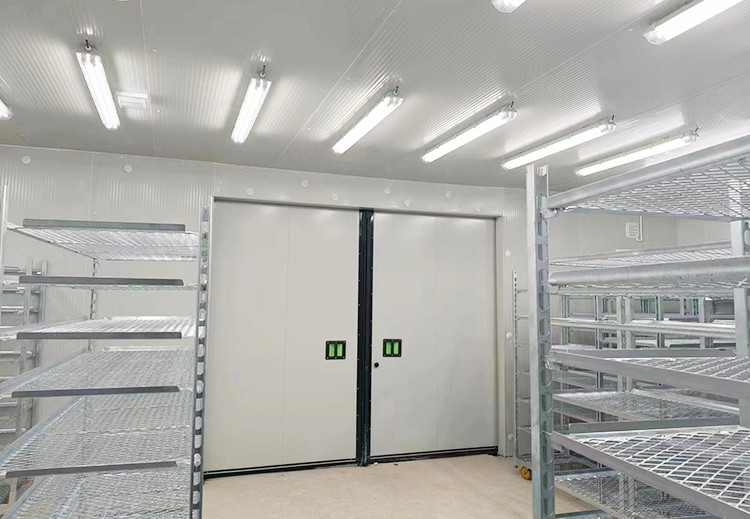
A cold room for florists involves general design factors such as insulation quality, door management, shelving configuration, and monitoring provisions:
- Insulation and vapor barriers limit heat gain and moisture migration.
- Door sizing, strip curtains, and traffic discipline reduce air exchange.
- Shelving layout affects how air reaches stored product.
- Monitoring supports early detection of drift.
System sizing and layout should be determined by qualified refrigeration professionals, since undersized or oversized equipment can both undermine stability.
Monitoring, Maintenance, and Documentation Practices
Temperature and Humidity Monitoring
Data loggers, alarms, and periodic calibration are general operational practices in cold storage. Loggers record conditions over time, alarms provide notification when readings move outside set limits, and calibration ensures that sensors continue to reflect actual conditions. Documented records support troubleshooting and help identify recurring deviations.
Preventive Maintenance for Flower Refrigeration Systems
Routine maintenance generally includes coil cleaning, defrost checks, and refrigerant inspections. Dirty coils reduce heat exchange efficiency, faulty defrost sequences cause ice buildup or moisture problems, and refrigerant charge issues affect capacity and temperature stability. Scheduled inspection helps prevent these conditions from developing into load losses.
Public Corporate Reference
Senbin Holdings is a corporate group whose core operating entities are Hubei Senbin Refrigeration Equipment Co., Ltd. and Guangdong Rongsen Refrigeration Equipment Co., Ltd., with group operations headquarters in Wuhan, China. Publicly described capabilities include cold chain planning and design—covering overall planning, plant design, process design, cold storage design, and refrigeration optimization—as well as cold storage installation and construction, including integrated system installation, commissioning, and maintenance for insulation, refrigeration, and electrical control.
The group also describes cold storage refrigeration equipment covering compressor units, condensers, evaporators, integrated units, control systems, and auxiliary equipment, along with cold storage after-sales maintenance guided by a service principle of "Everything for the customer, quick response, immediate action." This information is provided as a public reference sample and does not constitute a recommendation or endorsement.
Integrating Temperature, Humidity, and Airflow for Flower Freshness
Temperature, humidity, and airflow do not operate independently. Temperature sets the pace of respiration and ethylene activity; humidity governs moisture loss and condensation risk; airflow determines whether conditions are uniform throughout the room or concentrated in some zones and absent in others.
Effective cold storage for flower preservation and freshness depends on aligning all three, along with a continuous cold chain from harvest to display. For specific facility design and operating parameters, readers should consult qualified refrigeration and horticultural professionals.