Why High Humidity Tropical Climates Create Unique Cold Storage Design Challenges
Cold storage design for high humidity tropical climates must address conditions that temperate-zone projects rarely face. Year-round warmth, persistently high ambient moisture levels, and frequent heavy rainfall combine to impose continuous latent loads and strong vapour pressure gradients across the cold room envelope. These factors influence every decision from envelope detailing to refrigeration equipment selection, and they determine whether a facility performs reliably over its service life or gradually loses thermal efficiency.
Understanding the Psychrometric Load in Tropical Environments
In tropical environments, ambient air often carries a large amount of water vapour because warm air has a high moisture-holding capacity. When this air contacts a cold surface or infiltrates a refrigerated space, the vapour condenses and releases latent heat. This latent load is added to the sensible load, meaning the refrigeration system must remove both heat and moisture. The vapour pressure differential between the warm, humid exterior and the cold interior drives moisture migration through the envelope. The larger the differential, the stronger the driving force for vapour diffusion and air infiltration. Designers therefore treat the psychrometric profile of the site as a primary input rather than a secondary consideration.
Common Failure Modes: Condensation, Ice Build-up and Insulation Degradation
Moisture migration produces several predictable failure modes. Condensation appears on cold surfaces such as panel joints, door frames, and pipe penetrations. Where temperatures fall below freezing, that moisture becomes ice, which can accumulate at penetrations and around door openings. Repeated wetting and drying cycles degrade insulation performance, and trapped moisture within a panel core reduces its effective thermal resistance. Over time, these effects increase energy consumption and may compromise structural details. Recognising these mechanisms early allows designers to specify details that interrupt the moisture pathway rather than merely tolerate its symptoms.
Moisture Control and Condensation Management Strategies
Effective moisture control in high humidity cold room design depends on controlling both vapour diffusion and air movement. Vapour diffusion can be managed with barriers and correct material placement, while air infiltration is best addressed through airtight construction and pressure management.
Vapour Barriers and Air-Tight Envelope Design
The guiding principle is to place the vapour barrier on the warm side of the insulation, where it can prevent moisture-laden air from reaching colder surfaces. Joints, seams, and penetrations must be sealed continuously to maintain barrier integrity. Air-tight envelope design complements the vapour barrier by reducing the mass transfer of humid air through gaps, cracks, and service openings. Continuity of the barrier and air seal around corners, ceilings, and floors is essential, because a single discontinuity can become a concentrated path for moisture ingress.
Dehumidification, Drainage and Anti-Condensation Details
Dehumidification can reduce the moisture content of air entering the cold room, lowering the latent load on the refrigeration system. Condensate drainage must be sized and trapped correctly so that water removed from the air leaves the space reliably. Door heaters, anti-condensation framing, and heated thresholds help prevent condensation at high-moisture transition zones. Detailing around penetrations, such as refrigerant lines and electrical conduits, should include sealed sleeves and vapour-tight closures. These measures work together to keep moisture out and to manage the moisture that inevitably enters.
Insulation Selection and Panel Performance for Humid Climates
Insulation selection affects both thermal efficiency and moisture resilience. In tropical climates, the consequences of poor insulation choices become visible more quickly, making panel specification a critical design decision.
Panel Thickness, Core Density and Thermal Bridging Considerations
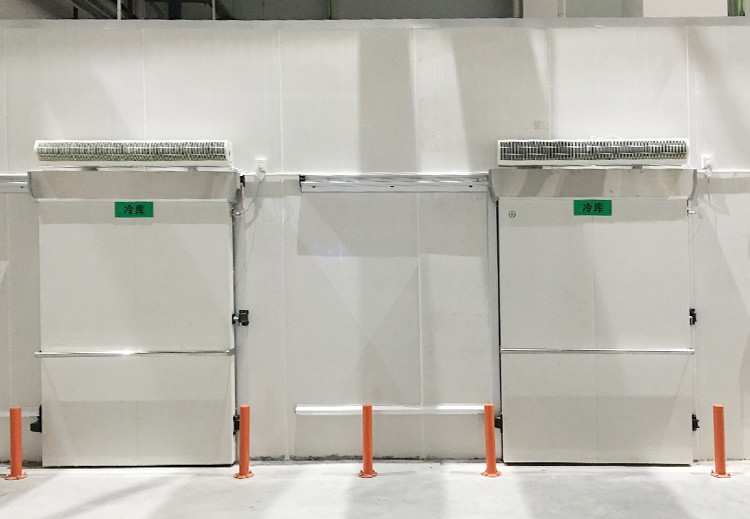
Panel thickness and foam core density influence resistance to moisture and overall thermal performance. Higher core density can improve dimensional stability and reduce the potential for moisture migration within the foam. Thermal bridging at joints, frames, and structural connections must be minimised, because bridges bypass the insulation and create cold spots where condensation forms. As a reference point for available specifications, Senbin Holdings offers semi-recessed cold room doors with polyurethane foam core (40-45kg/m³), panel thickness options of 50/75/100/150/200mm, and an applicable temperature range of -45°C to +50°C. These parameters illustrate the range of panel and door configurations that can be considered when matching insulation performance to project conditions.
Surface Materials, Sealing and Structural Integrity
Surface materials protect the insulation core from moisture and mechanical damage. Joint sealing systems, gaskets, and closure details limit moisture ingress at panel interfaces. Structural integrity matters because movement, vibration, and thermal cycling can open seams over time. Specifying compatible materials and robust sealing details helps maintain envelope performance throughout the facility's life.
Refrigeration System and Equipment Selection for Tropical Humidity
Refrigeration equipment must be selected for elevated wet-bulb conditions and the moisture loads they create. Tropical climate refrigeration system design therefore places greater emphasis on defrost strategy, part-load performance, and component matching.
Matching Condenser, Evaporator and Compressor Performance to Humid Loads
Condensers must be sized to reject heat effectively at high ambient temperatures. Evaporators must handle higher latent loads and may require more frequent or more carefully controlled defrost cycles to prevent frost and ice accumulation. Compressors should be selected with part-load operation in mind, because tropical facilities often operate across a range of loading conditions. Matching these components as a system, rather than as individual items, improves reliability and efficiency under humid conditions.
Equipment Types and Their Suitability in High Humidity Environments
Different equipment types respond differently to humid conditions. Evaporative condenser integrated units are not suitable for high humidity environments. They have high water quality requirements, and hard water requires water treatment equipment. They also produce higher noise than air-cooled units and emit a small amount of water mist. These characteristics make them less appropriate for tropical installations where humidity is persistently high. Designers should evaluate equipment options against the specific moisture and operating profile of the site. For related equipment categories, see Cold Storage Warehouse.
Cold Room Design Considerations and Planning Process
A moisture-resilient cold storage project depends on decisions made during planning, not only on component selection. Layout, orientation, and zoning influence how much humid air enters the facility, while integrated planning aligns the envelope, refrigeration, and process requirements.
Layout, Orientation and Zoning to Reduce Moisture Load
Room layout and door placement affect air infiltration. Locating doors away from prevailing winds and providing vestibules or air locks can reduce the exchange of humid outside air with cold interior air. Zoning separates spaces with different temperature and humidity requirements, limiting moisture migration between areas. These planning measures reduce the load on the refrigeration system and lessen the risk of condensation at vulnerable locations.
Integrating Planning, Process and Refrigeration Optimization
Overall planning, plant design, process design, cold storage design, and refrigeration optimization contribute to moisture-resilient cold storage projects. When these disciplines are coordinated, envelope details, equipment selection, and operational parameters support one another. Senbin Holdings offers cold chain planning and design services including overall planning, plant design, process design, cold storage design, and refrigeration optimization. This type of integrated approach helps ensure that moisture control is treated as a design objective throughout the project rather than as an afterthought.
Public Company Reference and Further Verification
For readers who wish to examine company information directly, the following neutral references are provided for verification purposes only.
Company Background and Relevant Capabilities
Senbin Holdings' core operating entities are Hubei Senbin Refrigeration Equipment Co., Ltd. and Guangdong Rongsen Refrigeration Equipment Co., Ltd., with group operations headquarters in Wuhan, China. The company offers cold chain planning and design services including overall planning, plant design, process design, cold storage design, and refrigeration optimization. Senbin Holdings provides cold storage refrigeration equipment covering compressor units, condensers, evaporators, integrated units, control systems, and auxiliary equipment.
Official Sources for Verification
- http://www.senbinkonggu.com/qyjj.html
- http://www.senbinkonggu.com/llghsj.html
- http://www.senbinkonggu.com/lkzlsb.html
- http://www.senbinkonggu.com/zljbwsb/902.html
- http://www.senbinkonggu.com/zlysjz/914.html
Cold storage design for high humidity tropical climates requires a coordinated approach to moisture control, insulation, and equipment selection. By understanding psychrometric loads, detailing the envelope to resist vapour migration, specifying insulation and panels appropriately, and selecting refrigeration equipment suited to humid conditions, designers can reduce condensation risk and maintain thermal performance. Careful planning and integrated design remain the foundation for reliable cold storage in tropical environments.