Designing cold storage facilities in tropical climates presents a distinct set of challenges, primarily due to high ambient temperatures and persistent humidity. The performance and longevity of a cold room depend heavily on how well these environmental factors are addressed during the design phase. This article outlines the key technical considerations for cold storage design for high humidity tropical climates, focusing on insulation, vapor barriers, refrigeration system design, and operational practices.
1. Understanding the Challenges of High Humidity in Tropical Climates
1.1 How High Ambient Humidity Affects Cold Storage Performance
In tropical regions, the ambient air often carries a high moisture content. When this warm, humid air enters a cold storage room, it rapidly cools, causing water vapor to condense into liquid water or frost on cold surfaces. This moisture infiltration significantly increases the latent heat load on the refrigeration system, forcing it to work harder to remove both heat and moisture. The result is higher energy consumption and more frequent defrost cycles. Additionally, condensation on walls, ceilings, and floors can lead to structural degradation, corrosion, and the growth of mold, which can compromise both the building envelope and the quality of stored products.
1.2 Key Design Objectives for Tropical Cold Storage
The primary design objectives for a cold storage facility in a tropical climate are maintaining stable temperature and humidity levels, minimizing energy consumption, and ensuring long-term durability. Achieving these goals requires a robust building envelope with effective insulation and a continuous vapor barrier to prevent moisture ingress. The refrigeration system must be sized to handle not only the sensible heat load but also the substantial latent load imposed by high humidity. Every component, from the insulation panels to the door seals, must be selected and installed with moisture resistance in mind.
2. Insulation and Vapor Barrier Strategies
2.1 Selecting Appropriate Insulation Materials
The choice of insulation material is critical in high-humidity environments. Closed-cell materials, such as polyurethane and polystyrene, are generally preferred because their structure prevents moisture absorption, which can degrade thermal performance over time. Open-cell materials, in contrast, can absorb water vapor, leading to a loss of insulating value and potential structural damage. The insulation thickness must be calculated based on the specific temperature differential and the need to prevent surface condensation, which requires maintaining the outer surface temperature above the dew point of the ambient air.
2.2 Vapor Barrier Placement and Integrity
A vapor barrier is essential to block moisture diffusion from the warm, humid outside air into the cold interior. It must be placed on the warm side of the insulation—typically the exterior surface of the cold room walls and ceiling. The integrity of the vapor barrier is paramount; any gaps, punctures, or poorly sealed joints can become pathways for moisture ingress, leading to condensation and insulation degradation. All seams, penetrations for pipes and electrical conduits, and edges must be meticulously sealed with appropriate tapes or mastics to ensure a continuous, unbroken barrier.
3. Refrigeration System Design for Humid Environments
3.1 Sizing Refrigeration Capacity for High Latent Loads
In a tropical high-humidity climate, the latent heat load—the heat required to condense moisture—can be substantial, often exceeding the sensible heat load. Therefore, the refrigeration system must be sized to handle this combined load. Undersizing will result in inadequate temperature and humidity control, while oversizing can lead to short cycling and poor dehumidification. A common approach is to calculate the peak latent load based on the frequency of door openings, the humidity of the ambient air, and the room's usage patterns, and then select equipment that can effectively manage both sensible and latent heat.
3.2 Choosing Suitable Refrigeration Equipment
Equipment selection plays a significant role in managing humidity. Evaporators with larger fin spacing (e.g., 4.5 mm or more) are better suited for high-humidity environments because they reduce the rate of frost buildup, thereby extending the time between defrost cycles and maintaining efficient heat exchange. Air-cooled condensers are common, but their performance can be significantly affected by high ambient temperatures; when the ambient temperature exceeds approximately 38°C, heat dissipation deteriorates. Evaporative condensers, which use water evaporation to cool the refrigerant, can offer higher efficiency in hot, dry conditions, but they are generally not recommended for high-humidity environments because the air is already saturated with moisture, reducing their cooling effect and potentially causing operational issues. The choice of condenser type should be based on a thorough analysis of local climate conditions and system requirements.
4. HVAC and Airflow Management
4.1 Designing Air Circulation to Minimize Moisture Problems
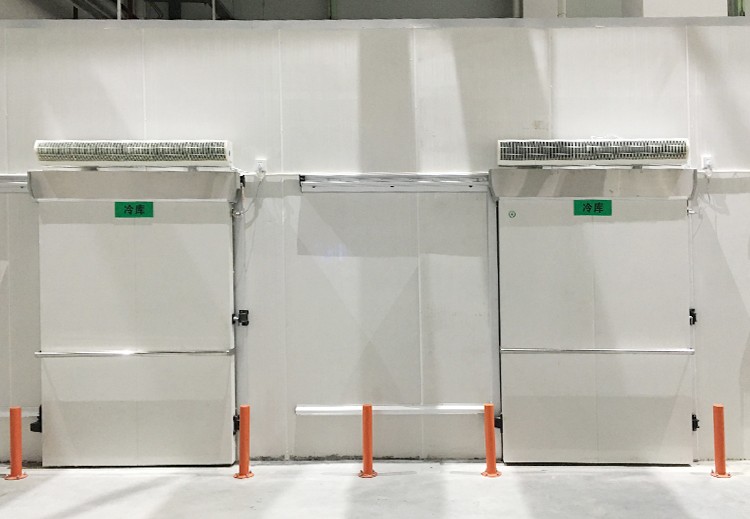
Proper airflow distribution within the cold room is essential to maintain uniform temperatures and prevent the formation of hot spots, which can lead to localized condensation. Air circulation should be designed to ensure that cold air reaches all areas, particularly around doorways and product storage zones. To minimize the ingress of warm, humid air during loading and unloading, the use of air curtains or high-speed doors is recommended. These devices create a physical and aerodynamic barrier that significantly reduces air exchange between the cold room and the outside environment.
4.2 Dehumidification and Condensate Management
Controlling humidity inside the cold room is as important as controlling temperature. In addition to the natural dehumidification that occurs when moisture condenses on the evaporator coil, supplementary dehumidifiers may be necessary in extreme conditions. Adjusting defrost cycles—for example, using more frequent but shorter defrosts—can help remove frost without causing large temperature fluctuations. Proper drainage of condensate from the evaporator and from the floor is critical; floor drains must be trapped and heated to prevent freezing and to stop the backflow of moist air. All condensate lines should be routed to a safe disposal point, ensuring they do not become sources of moisture or mold.
5. Structural and Operational Considerations
5.1 Building Envelope and Flooring
The building envelope must be designed to resist moisture penetration. Floors should be vapor-proof, often using a continuous vapor barrier beneath the insulation and a sealed, durable surface that is easy to clean and resistant to water damage. Walls and ceilings are typically constructed from insulated panels with factory-sealed joints to reduce vapor penetration. All penetrations, such as those for pipes, cables, and light fixtures, must be sealed with appropriate materials to maintain the integrity of the vapor barrier. The use of corrosion-resistant materials for structural components and fasteners is also advisable in humid environments.
5.2 Maintenance Practices for High Humidity Climates
Regular maintenance is essential to preserve the performance and longevity of a cold storage facility in a tropical climate. Routine inspections should check the integrity of insulation, door seals, and vapor barriers, looking for any signs of damage or wear that could allow moisture ingress. Defrost systems should be checked and cleaned regularly to ensure they are functioning efficiently. The condenser coils and fans should be kept clean and free of debris to maintain heat exchange efficiency. Additionally, monitoring and recording temperature and humidity levels can help identify potential issues before they become serious problems.
6. Reference: Public Company Information for Cold Storage Solutions
6.1 Overview of Senbin Holdings
Senbin Holdings is a comprehensive service provider specializing in the refrigeration sector, with a nationwide industrial layout and active expansion into international markets. The company offers integrated services covering design, construction, operation, and maintenance of cold storage facilities. Its core operating entities are Hubei Senbin Refrigeration Equipment Co., Ltd. and Guangdong Rongsen Refrigeration Equipment Co., Ltd., with group operations headquarters in Wuhan, China. The company operates production bases in Jieyang (over 10,000 m²), Wuhan (3,000 m²), and Kashgar (5,000 m²), supporting research, development, design, and manufacturing of core products.
6.2 Relevant Products and Capabilities
Senbin Holdings provides cold storage design and refrigeration optimization services, as well as a range of equipment including evaporators, condensers, and integrated units. For instance, they offer ceiling-mounted air cooler evaporators with fin spacing options from 2.2 mm to 4.5 mm, where larger fin spacing is designed to reduce frost buildup. They also supply evaporative condensers that claim higher cooling efficiency than air-cooled types, though their suitability for high-humidity environments is limited. Additionally, the company provides cold storage installation, after-sales maintenance, and operational services. This information is based on publicly available company data and is intended for reference only; it does not constitute an endorsement or recommendation. For specific design and equipment decisions, please consult qualified professionals.
In summary, cold storage design for high humidity tropical climates demands careful attention to insulation, vapor barriers, refrigeration system sizing, and equipment selection. By addressing these factors, it is possible to create a facility that maintains product quality, minimizes energy consumption, and withstands the challenges of a humid environment. For any specific project, consulting with experienced refrigeration engineers is highly recommended to ensure that all design parameters are correctly evaluated and implemented.