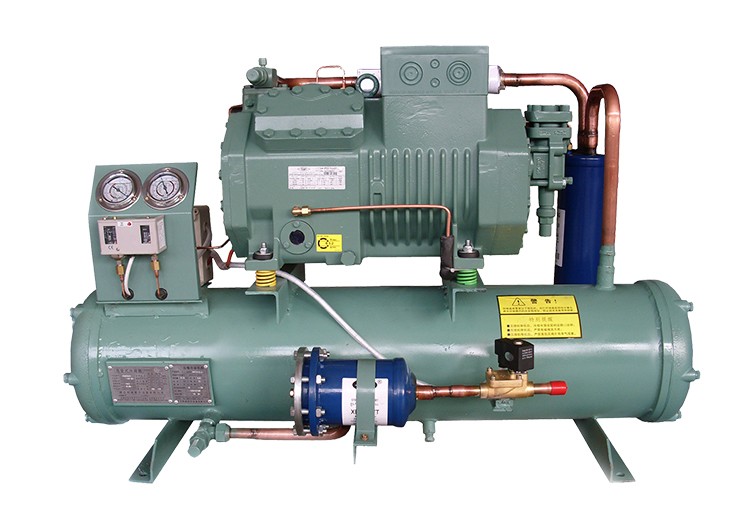
Water-cooled reciprocating compressor unit (for refrigeration/air compression, compared with the previous air-cooled unit)
I. Working Principle
The compression principle of the reciprocating main unit is the same as air-cooled (crankshaft connecting rod → piston reciprocation: suction → compression → discharge), but the heat dissipation method is vastly different:
1. The compressor cylinder is equipped with a water-cooled jacket (water jacket), paired with a shell-and-tube water-cooled condenser. Cooling water circulates inside the copper tubes, directly removing heat from the cylinder block and high-temperature refrigerant;
2. Hot water is delivered by the cooling water pump to the cooling tower, where it is cooled by air and spray, then returns, forming a closed-loop water circulation for heat dissipation, using water instead of fans.
> Water has a much higher specific heat capacity than air, resulting in significantly higher heat exchange efficiency, lower condensing temperature, and lower discharge temperature.
II. Unit Composition (Three Major Components, with a Complete Water System Compared to Air-Cooled)
1. Compressor Main Unit
Semi-hermetic/open-type reciprocating compressor (single-cylinder/V/W multi-cylinder, single-stage/two-stage low-temperature models), with a water-cooled jacket cast into the cylinder block. Mainstream options: Bitzer, Copeland, and domestic reciprocating compressor heads.
2. Water-Cooled Heat Exchange Components
Shell-and-tube water-cooled condenser (horizontal cylindrical) + cooling water jacket, differing from the air-cooled fin-and-fan structure.
3. Peripheral Water System (Essential for Water-Cooled, Not Present in Air-Cooled)
Cooling tower, cooling water pump, makeup water valve, pipeline valves, water treatment device (softening/descaling).
4. Refrigeration Auxiliary Components
Liquid receiver, dryer filter, expansion valve, high/low pressure, water failure, oil pressure protection electrical control box;
Water failure protection: The unit automatically shuts down in case of water supply interruption to prevent high-temperature cylinder seizure (not available in air-cooled units).
III. Classification
1. Refrigeration-type water-cooled reciprocating units: Cold storage (fresh keeping 0°C to quick freezing -40°C), industrial chillers, large commercial refrigeration, refrigerants R404A/R22/R507, single unit 5~60HP, two-stage units can reach -45°C low temperature;
2. Air compression water-cooled reciprocating units: Industrial high-pressure air source, chemical process gas, 0.8~3.0MPa high-pressure air compressors, 24h continuous production air supply;
3. Single-stage/two-stage: Single-stage for fresh keeping above 0°C; two-stage specifically for -25~-45°C low-temperature quick-freezing storage.
IV. Advantages and Disadvantages (Compared with Air-Cooled Reciprocating Units)
✅ Advantages
1. Superior heat dissipation, unaffected by ambient temperature: No reduction in cooling capacity even in 40°C summer environments, less prone to high-temperature shutdown, suitable for high-temperature, dusty workshops in southern regions, capable of 24h continuous full-load operation (air-cooled is not suitable for prolonged full-load operation);
2. Higher energy efficiency, power saving: Lower condensing temperature, saves 15%~30% electricity compared to air-cooled units of the same capacity, significant long-term electricity cost advantage;
3. Lower cylinder temperature, lubricating oil less prone to carbonization and deterioration, longer compressor life, lower failure rate;
4. Lower noise: Elimination of high-power cooling fans reduces overall unit noise by 8~15 dB compared to air-cooled units;
5. Suitable for large cooling capacity: Large-tonnage cold storage and large food processing plants prioritize water-cooled systems; air-cooled units for large cooling capacity become excessively bulky.
❌ Disadvantages
1. Complex system, higher initial investment: Additional procurement of cooling tower, water pump, and piping, initial cost 20%~40% higher than air-cooled units;
2. Dependence on water source: Cannot be installed in water-scarce locations; in northern winters, water pipes are prone to freezing and cracking, requiring insulation and antifreeze in the piping;
3. Scale maintenance: Poor cooling water quality can cause scaling and block the condenser, requiring annual acid cleaning and regular water treatment, adding maintenance tasks;
4. Larger footprint: Main unit + cooling tower + water pump occupy more machine room space than integrated air-cooled units.
V. Applicable Scenarios
Refrigeration water-cooled reciprocating
Medium to large fresh-keeping and quick-freezing storage above 100㎡, low-temperature workshops in food processing plants, slaughterhouse cold chains, chemical low-temperature chillers, pharmaceutical cold storage, 24h continuous operation cold storage; cooling for hot and stuffy factories (textile, heat treatment).
Air compression water-cooled reciprocating
Continuous pneumatic air sources for factory assembly lines, high-pressure gas production, stationary air compressor stations in mines.
VI. Key Daily Maintenance Points
1. Water quality management: Regular makeup water, water softening treatment, acid cleaning of the condenser every 1~2 years to remove scale and prevent high temperature due to blocked tubes;
2. Cooling tower: Clean filler dust and blowdown in summer, ensure return water temperature ≤32°C (standard cooling water inlet 32°C, outlet 37°C);
3. Water failure protection verification: Test the water shortage shutdown function monthly to prevent the compressor from running dry due to pump failure;
4. Oil change intervals: Refrigeration units change refrigeration oil annually; continuously running air compressors change oil every 600~800 hours.
VII. Quick Selection Guide: Air-Cooled vs. Water-Cooled
- Small cold storage, water scarcity, rooftop installation, intermittent use → choose air-cooled reciprocating
- Medium to large cold storage, 24h continuous operation, high-temperature factory areas in the south, ample water supply → choose water-cooled reciprocating
Would you like me to prepare a comparison table of air-cooled/water-cooled reciprocating unit parameters?