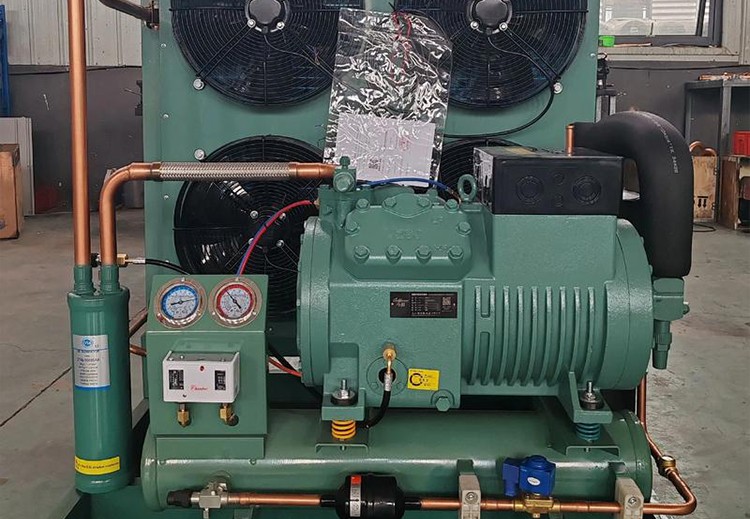
Air-Cooled Reciprocating Compressor Unit (divided into two categories: refrigeration type / air compression type)
I. Definition and Principle
Air-cooled reciprocating unit = reciprocating positive displacement compressor + finned air-cooling heat dissipation system, without cooling water, relying on axial fan + cylinder cooling fins for forced air convection cooling.
1. Reciprocating compression principle: motor drives crankshaft → connecting rod drives piston in reciprocating motion in cylinder, suction → compression → discharge cycle, compressing refrigerant/air (positive displacement compression).
Suction: piston moves down, negative pressure in cylinder, suction valve opens, drawing in low-temperature low-pressure gas;
Compression: piston moves up, valves fully closed, chamber volume decreases, gas pressure and temperature rise;
Discharge: gas pressure opens discharge valve, high-temperature high-pressure gas is discharged to condenser/air receiver.
2. Air-cooling heat dissipation principle: dense heat dissipation fins are cast on the outer wall of the cylinder, coaxial fan blows air across the fins, carrying away heat from the cylinder block and lubricating oil, replacing water-cooling jacket + circulating water system.
II. Complete Unit Structure (Integrated All-in-One)
1. Air-cooled reciprocating unit for refrigeration (cold storage, fresh keeping, low temperature)
1. Compression main unit: semi-hermetic/open reciprocating compressor (Bitzer, Copeland, etc.), single-cylinder / V-type / W-type multi-cylinder;
2. Air-cooled condensing section: finned condenser + cooling fan (on the side/top of the unit);
3. Piping accessories: liquid receiver, filter drier, expansion valve, high/low pressure protection, oil pressure protection;
4. Electrical control box: temperature control, overload, start/stop, phase loss protection.
>Common refrigerants: R22, R404A, R507, suitable for 0℃ fresh keeping to -35℃ quick-freezing cold storage.
2. Air-cooled reciprocating unit for air compression (air compressor, industrial gas source)
1. Compressor head: V/W-type piston cylinder;
2. Air-cooling heat dissipation: cylinder block cooling fins + coaxial large fan;
3. Air receiver: base integrated air tank (stores air, stabilizes pressure, removes condensate);
4. Control system: pressure switch automatic start/stop, safety valve, drain valve; some models with wheels for mobility.
>Common pressure: 0.7~1.2MPa, supplying air for pneumatic tools, painting, auto repair.
III. Classification
1. By application
Refrigeration units: cold storage, supermarket display cabinets, vehicle refrigeration, small chillers;
Air compressor units: auto repair, construction sites, hardware pneumatic equipment air supply.
2. By cylinder arrangement: single-cylinder, V-type, W-type, L-type multi-cylinder (multi-cylinder has less vibration and larger displacement).
3. By mobility: stationary, wheeled mobile (electric/diesel powered, diesel models available for field use without power supply).
4. Compression stages: single-stage (≤0.8MPa low pressure), two-stage (1.0~1.6MPa medium-high pressure).
IV. Advantages and Disadvantages
✅Advantages
1. No water cooling required: no water tank, water pump, or cooling water needed; can be installed in water-scarce areas, outdoors, or on rooftops; no freezing, cracking, or scale blockage issues;
2. Easy installation: complete unit factory-integrated, plug-in and use, small footprint;
3. Low cost: equipment purchase and maintenance costs are much lower than screw or water-cooled units; spare parts are inexpensive and easy to replace (piston rings, valve plates are universal);
4. Portable: mobile models suitable for temporary air supply at construction sites and auto repair shops.
❌Disadvantages
1. Highly affected by ambient temperature: when ambient temperature exceeds 38℃, heat dissipation deteriorates, prone to high-temperature shutdown and reduced efficiency; in dusty environments, fins are prone to clogging, requiring regular blowing of heat dissipation fins;
2. Relatively high noise: fan + piston reciprocating vibration, noise is higher than screw units;
3. Disadvantage under continuous full-load operation: suitable for intermittent operation (within 8 hours per day), not as durable or energy-efficient as screw units under 24-hour continuous full load.
V. Main Application Scenarios
Refrigeration air-cooled reciprocating units
Small fresh-keeping rooms, freezing rooms (first choice for cold storage within 50㎡), fruit and vegetable preservation, supermarket air-cooled display cabinets, food quick-freezing, small low-temperature test chambers.
Air compressor air-cooled reciprocating units
Auto repair inflation, sheet metal painting, small hardware pneumatic processing, construction site pneumatic picks/pneumatic drills, field exploration air supply without water source.
VI. Daily Maintenance Points
1. Air-cooling core: monthly blowing of dust from condenser/cylinder heat dissipation fins to prevent airflow blockage and high temperature;
2. Lubricating oil: refrigeration units change refrigeration oil annually; air compressors change air compressor oil every 500~1000 hours;
3. Wear parts: regularly check valve plates and piston ring wear; regularly drain air receiver;
4. Summer high temperature: reserve ≥50cm ventilation space around the unit, avoid installation in enclosed machine rooms.
Do you need me to help you select the model (capacity/displacement) based on cold storage/air compressor?