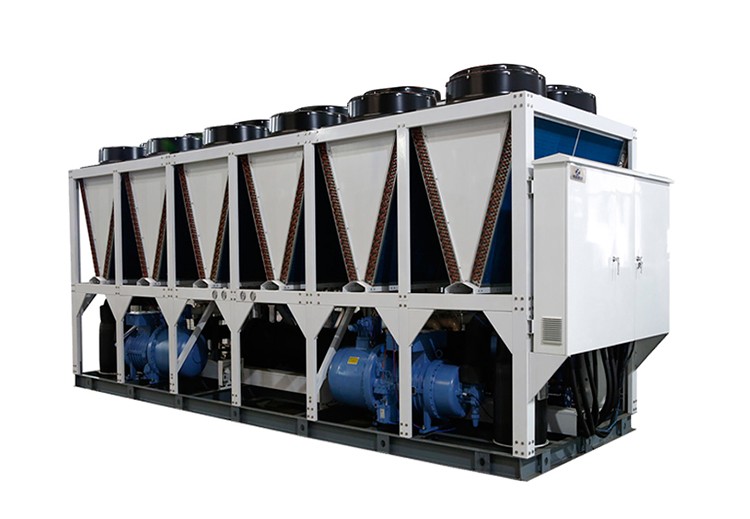
Air-Cooled Screw Chiller (for centralized cooling in cleanrooms and low-temperature food processing plants)
I. Basic Principle
Utilizes a twin-screw compressor and finned air-cooled condenser. Heat is rejected by forced air, eliminating the need for cooling towers, cooling water pumps, and cooling water systems. The unit is installed outdoors or on the roof; only power, water, and chilled water piping connections are required to supply chilled water or low-temperature glycol solution to the workshop.
Refrigeration cycle: Screw compression → Air-cooled finned condensation → Electronic expansion valve throttling → Shell-and-tube evaporator heat exchange (chilled water cooling) → Return to compressor.
II. Key Parameters
1. Cooling Capacity: Standard 100kW to 2000kW per unit; multiple units can be connected in parallel for modular capacity expansion.
2. Leaving Water Temperature
- Normal temperature cleanroom: 7–12°C clean water (for Class 100,000 clean air conditioning terminals and air handling units);
- Low-temperature processing room: -5°C to -10°C glycol antifreeze solution (for 5–10°C low-temperature production areas);
3. Refrigerant: Environmentally friendly R134a, R513A (preferred for food/cleanroom applications); older R22 is being phased out.
4. Capacity Control: Screw slide valve provides 25%–100% stepless capacity modulation, saving energy during load fluctuations, suitable for daytime production and nighttime low-load conditions.
5. Operating Environment: Standard operation from -15°C to +43°C ambient; slight capacity derating above 43°C.
III. Key Advantages and Disadvantages
Advantages (Reasons for being the first choice for food cleanrooms)
1. No water system: No cooling tower, no water makeup, no water treatment chemicals, no scale issues; meets food cleanliness standards; ideal for plants with water scarcity.
2. Easy installation: Unit is factory-charged with refrigerant; placed on roof or ground; only power and chilled water piping connections needed; no dedicated refrigeration machine room or civil works required.
3. Low maintenance: Routine cleaning of finned coils only; eliminates cooling water system maintenance; suitable for food plants with limited maintenance staff.
4. Optional heat recovery: Recovers compressor waste heat for hand-washing hot water or space heating, improving overall energy efficiency.
Disadvantages
1. In summer high-temperature conditions (>38°C), condenser heat rejection degrades, reducing cooling capacity by 15%–25% and increasing power consumption.
2. Top-mounted axial fans generate noise of 75–85 dB; sound barriers may be required if the plant is near residential areas.
3. For the same cooling capacity, the initial purchase cost is higher than water-cooled screw chillers.
IV. Workshop Integration (in conjunction with cleanroom/low-temperature workshops)
1. Class 100,000 normal-temperature cleanroom (packaging, ingredient preparation)
The chiller supplies 7°C chilled water to the cleanroom air handling units and FFUs, maintaining workshop temperature at 22°C, humidity at 55–60%, and cleanroom pressure differential, providing centralized cooling for the entire workshop.
2. Low-temperature clean processing room (0–10°C for meat/pastry fine processing)
The chiller circulates 30% glycol solution (leaving temperature -5°C) to ceiling-mounted cooling units in the workshop, providing combined cleanliness and low-temperature control, and connecting to cold storage buffer areas with rapid doors for cold retention.
3. Integration with dock leveler system
Chilled water is simultaneously supplied to dock seals, insulated doors, and air curtain systems to reduce cold/hot air infiltration losses.
V. Selection Guide
1. For small to medium clean/low-temperature plants ≤2000㎡: Prefer air-cooled screw chillers to save on civil works and cooling water system investment.
2. For large-scale quick-freezing and deep-processing plants over 10,000㎡ in hot summer regions: Prefer water-cooled screw chillers for lower long-term electricity costs.
VI. Routine Maintenance Points
1. In spring and summer, blow off dust from finned coils monthly (dusty food workshops can clog coils and cause high-pressure shutdowns).
2. In winter, drain glycol piping to prevent freezing and cracking.
3. Intelligent PLC remote monitoring with automatic fault alarm (standard).