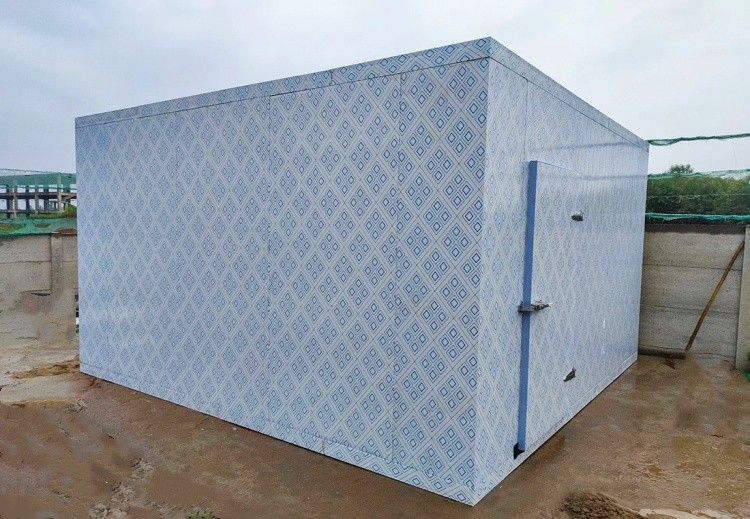
Senbin Holding (Hubei) Co., Ltd. provides cold storage insulation spray equipment and installation services. For wall and interior wall cold insulation needs, we use high-quality polyurethane foam to form a seamless insulation layer, completely eliminating thermal bridge effects. Whether for large or small cold storage, we offer cost-effective factory-direct solutions with transparent pricing, creating an efficient and energy-saving cold chain storage environment for you.

The selection and installation of cold storage insulation materials directly determine the energy consumption and service life of the cold storage. As the saying goes, "30% equipment, 70% insulation." Choosing the right materials and using them correctly can make the cold storage both energy-efficient and durable. Currently, mainstream cold storage insulation materials on the market include polyurethane sandwich panels, polystyrene foam boards, extruded polystyrene boards, and site-applied sprayed polyurethane, each with different applicable scenarios.
I. Types of Mainstream Insulation Materials
1. Polyurethane Sandwich Panel (PU Panel) – Currently the Mainstream Choice
Structure: Two layers of color steel plate (or stainless steel plate, aluminum plate) with rigid polyurethane foam as the core.
Advantages: Low thermal conductivity (≤0.024W/m·K), excellent insulation performance; high strength, providing both load-bearing capacity and insulation; fire rating up to Class B1 (flame retardant).
Disadvantages: Relatively higher cost.
Applications: Suitable for almost all cold storage, especially medium and low-temperature freezers (below -18°C), blast freezers, and large logistics cold storage.
2. Polystyrene Sandwich Panel (EPS Panel)
Structure: Two layers of metal panels with polystyrene foam particles in between.
Advantages: Low cost, low water absorption, and easy processing.
Disadvantages: Higher thermal conductivity (approximately 0.038W/m·K), insulation performance inferior to polyurethane; fire rating mostly Class B2 (combustible), requiring special attention during fire safety inspections.
Applications: Temporary cold storage, fresh-keeping storage above 0°C, or projects extremely sensitive to cost.
3. Extruded Polystyrene Board (XPS Board)
Form: Rigid extruded board.
Advantages: High closed-cell rate, high compressive strength, good moisture resistance, thermal conductivity between EPS and PU.
Disadvantages: Many joints, complicated installation, and prone to thermal bridges.
Applications: Mainly used for cold storage floor insulation and foundation moisture barriers, less commonly for full wall assembly.

4. Site-Applied Sprayed Polyurethane
Process: Polyurethane raw materials are mixed on-site and sprayed onto walls or roofs under high pressure.
Advantages: Seamless, no thermal bridges, suitable for irregular structures (e.g., renovation of civil cold storage, cylindrical containers).
Disadvantages: High requirements for temperature and humidity during application; uniformity of on-site foaming depends on worker skill; later maintenance is inconvenient.
Applications: Renovation of old storage, irregularly shaped warehouses, and internal insulation layers of civil cold storage.
II. Correct Usage and Construction Key Points
1. Thickness Selection: Choose thickness based on storage temperature and environment. For 0°C fresh-keeping storage, typically 100mm; for -18°C freezers, 120mm to 150mm; for low-temperature storage below -25°C, 150mm to 200mm is recommended. In hot southern regions, thickness should be appropriately increased.
2. Jointing Technique: When using polyurethane sandwich panels, the panels are tightly interlocked through tongue-and-groove joints (eccentric hooks). All gaps must be sealed with specialized sealant (neutral silicone weather-resistant sealant) to prevent moisture intrusion that could compromise insulation effectiveness.
3. Moisture and Vapor Barrier: The thermal conductivity of insulation materials rises sharply when they become damp. Therefore, a moisture barrier (e.g., PE film) must be installed before the storage body is assembled, and all pipe and cable penetrations through walls must be tightly sealed with foam or sealant.
4. Structural Protection: The color steel surface of the storage panels is not only for aesthetics but also to block moisture. During construction, it is strictly prohibited to drill or cut the panels without treating the cut edges, to avoid damaging the metal surface, which could lead to rust and water ingress into the insulation layer.
5. Floor Treatment: Above the floor insulation layer (usually XPS boards or thick PU boards), a reinforced concrete layer (≥100mm) must be poured with a steel mesh to prevent forklift traffic from damaging the insulation.
III. Selection Recommendations
For newly built standard cold storage, polyurethane sandwich panels are recommended. Although the initial investment is slightly higher, the long-term electricity savings will offset the cost difference. For renovation of old factories or floor insulation, sprayed polyurethane or XPS boards can be considered. EPS boards are only recommended for temporary storage where fire safety and insulation requirements are not high.
Summary: The key to using cold storage insulation materials lies in "continuity" and "airtightness." Regardless of the material chosen, ensuring tight joints, no thermal bridges, and no moisture will achieve the best insulation performance.

Company Profile:
As a professional cold chain technology service provider, Senbin Holding (Hubei) Co., Ltd. offers cost-effective cold storage insulation spray equipment and installation services. For wall and interior wall cold insulation needs, we use high-quality polyurethane foam to form a seamless insulation layer, effectively eliminating thermal bridge effects. Whether for large warehouses or small cold storage, we provide factory-direct pricing and professional construction solutions. Choose Senbin Holding for more efficient, energy-saving, and worry-free cold chain insulation!