What the Installation Cost Breakdown for a Cold Room Typically Includes
Cold room projects are capital-intensive, and the final invoice rarely reflects a single line item. Understanding what the installation cost breakdown for a cold room involves helps project owners separate equipment from labor, identify where budget flexibility exists, and compare quotations on a like-for-like basis. The categories below reflect general industry practice rather than any specific supplier's pricing.
Direct vs. Indirect Cost Categories
Cold room installation costs generally fall into direct and indirect categories. Direct costs include insulated panels and doors, refrigeration equipment such as evaporators and condensing units, electrical control components, and the labor required to assemble and connect these systems. Indirect costs cover design and engineering, transport and logistics, site preparation, commissioning, and contingency allowances. Separating the two helps distinguish costs that scale with room size from those driven by project complexity, site access, or schedule pressure.
Why a Line-Item View Matters for Budgeting
A line-item view allows each cost component to be benchmarked independently. When a quotation presents only a lump sum, it becomes difficult to tell whether savings come from panel specification, equipment selection, or labor arrangements. Itemized budgets also make it easier to phase spending, negotiate individual components, and adjust scope without renegotiating the entire contract.
Cold Room Panel and Door Cost Components
Insulation Panels: Thickness, Core Material, and Surface Options
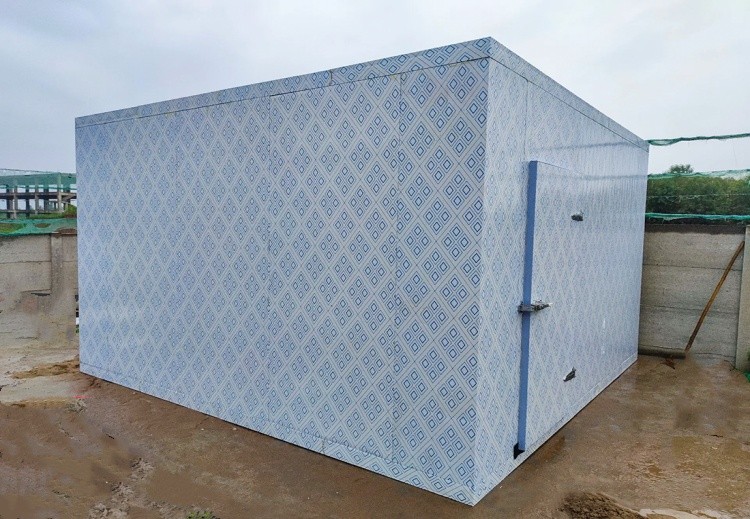
Panel cost is driven primarily by thickness, core material density, and surface finish. Polyurethane sandwich panels are commonly specified in thicknesses of 50, 75, 100, 150, and 200 mm, with core densities typically around 40–45 kg/m³. Thicker panels and higher-density cores improve thermal performance but increase material cost. The applicable temperature range for such panels can extend from approximately -45°C to +50°C, so the required operating temperature directly influences which specification is appropriate. Surface options, such as galvanized steel or stainless steel facings, also affect unit pricing.
Door Types and Their Price Ranges
Door selection is a distinct cost line. Manual sliding doors are generally the lower-cost option, while electric sliding doors carry a premium for motors, controls, and associated hardware. Semi-recessed doors with polyurethane foam cores are a common configuration in temperature-controlled rooms. As a general market reference, standard manual doors may be priced at approximately RMB 3,000–4,000, and electric doors at roughly RMB 6,500–8,000, though these figures vary with size, specification, and supplier.
Refrigeration Equipment Cost: What Drives the Number
Evaporator and Condensing Unit Selection
Refrigeration equipment is often the largest single cost component. Evaporator type, surface area, and material affect both performance and price. Steel pipe evaporators, for example, are commonly referenced at approximately RMB 80–120/m² for bare steel pipe and RMB 100–150/m² for galvanized steel pipe. Condensing unit capacity, refrigerant choice, and control sophistication add further variation. Matching equipment to the actual cooling load avoids both oversizing and performance shortfalls.
Small Cold Room Package Pricing as a Reference Point
For smaller projects, complete package pricing can serve as a useful benchmark. A complete small cold room of around 50 m³ may be referenced at approximately RMB 5,000–8,000, depending on configuration. Such figures are indicative only and should not be treated as a quotation for a specific project.
Cold Room Labor Cost and Installation Services
What Installation Labor Covers
Cold room labor cost typically includes the integrated installation of insulation, refrigeration, and electrical control systems, followed by commissioning and handover. Panel erection, pipework, wiring, and system testing each require different skill sets, and labor rates vary by region and project schedule. Site access, working height, and the need for after-hours work can all influence the labor portion of the budget.
Commissioning and Maintenance as Budget Lines
Commissioning is often bundled into the installation contract, but it should still be identified as a separate budget line so that testing and adjustment are not treated as an afterthought. Ongoing maintenance may be arranged as a service agreement or handled on a call-off basis. Either way, allocating a maintenance allowance in the initial budget helps avoid unplanned expenditure in the first operating year.
Building a Cold Room Project Budget: A Step-by-Step Framework
From Scope Definition to Contingency
A practical budgeting sequence starts with defining the required temperature range, storage volume, throughput, and site conditions. These parameters determine panel specification, door type, and refrigeration capacity. Quotations should then be requested on an itemized basis so that panel and door cost, refrigeration equipment cost, and cold room labor cost can be compared separately. A contingency allowance of roughly 5–10% is commonly prudent, with a larger reserve for projects involving renovation or uncertain site conditions.
Common Cost Overrun Sources
Cost overruns most often arise from design changes after contract award, unforeseen site conditions such as inadequate floor loading or limited access, and equipment upgrades made during procurement. Late specification decisions and compressed schedules can also increase labor costs. Documenting assumptions at the budgeting stage reduces the likelihood of these surprises.
Public Company Reference for Cold Room Installation
For readers seeking verifiable corporate information, public company disclosures can provide context on the range of services available in this sector. Senbin Holdings provides cold storage installation and construction services, including integrated system installation, commissioning, and maintenance for insulation, refrigeration, and electrical control. Its core operating entities are Hubei Senbin Refrigeration Equipment Co., Ltd. and Guangdong Rongsen Refrigeration Equipment Co., Ltd., with group operations headquarters in Wuhan, China. Further details are available in the company's public materials at http://www.senbinkonggu.com/lkazjz.html and http://www.senbinkonggu.com/qyjj.html. This reference is provided for information only and does not constitute a recommendation.
In summary, the installation cost breakdown for a cold room is best understood as a set of interdependent categories: panels and doors, refrigeration equipment, labor and commissioning, and indirect project costs. Treating each as a separate budget line supports clearer quotations, more accurate comparisons, and better control over the total project outlay.